Massimo Luciani

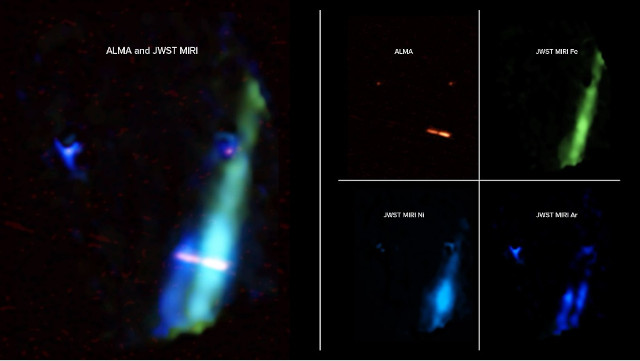
The WL20S system in a combination of ALMA and Webb observations

At the 244th Meeting of the American Astronomical Society, a study was presented of what turned out to be a pair of stars inside the WL20 group, cataloged as WL20S. The authors of this study combined observations conducted with the ALMA radio telescope and the James Webb Space Telescope to obtain the information necessary to establish that in that system there are two young stars, and not one as astronomers thought, which formed between 2 and 4 million years ago. Both stars are surrounded by disks of materials in which there could be planets forming and parallel jets of materials emitted by the two stars.

The Ceraunius Tholus volcano as seen by the TGO space probe's CaSSIS instrument with the frost in blueish

An article published in the journal “Nature Geoscience” reports the detection of frost on volcanoes in the Tharsis region on Mars. A team of researchers used data obtained from two ESA space probes, the ExoMars mission’s TGO and Mars Express, which made it possible to discover for the first time the presence of frozen water on the Martian surface at the red planet’s equator. In the calderas of the big volcanoes of Tharsis, blue deposits that can be attributed to water ice were spotted which are present only in the morning and then evaporate a few hours later.

Views of the Starliner Calypso spacecraft approaching the International Space Station in its Boe-CFT mission (Image NASA TV)

A few hours ago, Boeing’s CST-100 Starliner Calypso spacecraft docked with the International Space Station’s Harmony module, completing the first leg of its Boe-CFT (Boeing Crewed Flight Test) mission which began with the launch just over 24 hours earlier. After checking that the pressure was correctly balanced, the hatch was opened to allow Butch Wilmore and Suni Williams to enter the Station and begin their mission, which will last about a week.

Super Heavy 11 and Starship 29 after blasting off (Image courtesy SpaceX)

SpaceX conducted a new flight test of its Super Heavy rocket and Starship prototypes, launched from its base in Boca Chica, Texas. This is the fourth test involving the entire system of Elon Musk’s company which is supposed to revolutionize space travel with an unprecedented transport capacity and being totally reusable. In this case, however, they are prototypes with the Super Heavy identified as Booster 11 and the Starship identified as Starship 29 or Ship29 or simply S29. Each test leads to new changes to the vehicles’ systems and this happened after the third test conducted on March 14, 2024, as well. The vehicles still don’t meet the safety requirements needed to conduct controlled landings, so plans continue to call for the test to end with the splashdown of both vehicles.

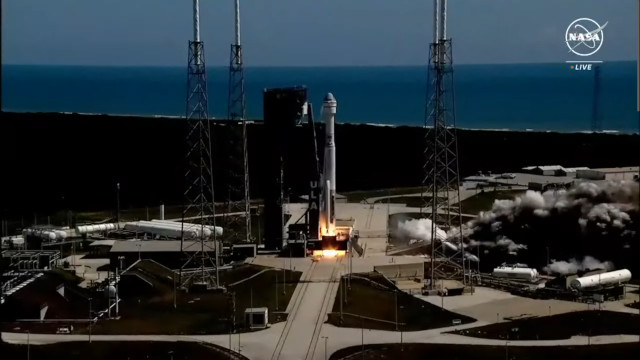
The CST-100 Starliner Calypso spacecraft blasting off atop an Atlas V rocket (Image NASA)

A little while ago, Boeing’s CST-100 Starliner Calypso spacecraft blasted off atop a ULA Atlas V rocket from the Cape Canaveral base on its Boe-CFT (Boeing Crew Flight Test) mission. After about fifteen minutes, it successfully separated from the rocket’s last stage and soon it will start the maneuvers it needs to enter orbit and begin tracking the International Space Station.