Massimo Luciani

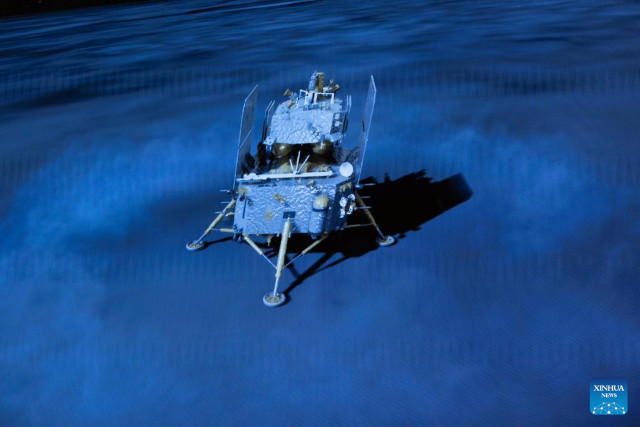
Animation of the lander and ascent module of the Chang'e-6 mission (Image courtesy Xinhua/Jin Liwang)

It was early morning in China when the lander and ascent module of the Chinese Chang’e-6 mission successfully completed their Moon landing maneuvers in the South Pole-Aitken basin area. The various modules that make up Chang’e-6 were launched on May 3 and reached lunar orbit in recent days. At that point, a series of maneuvers began to make the orbit circular, the modules that were supposed to land on the Moon separated and everything went well. In that area, direct communications with Earth are impossible, so contact was maintained using the Queqiao-2 satellite as a relay.

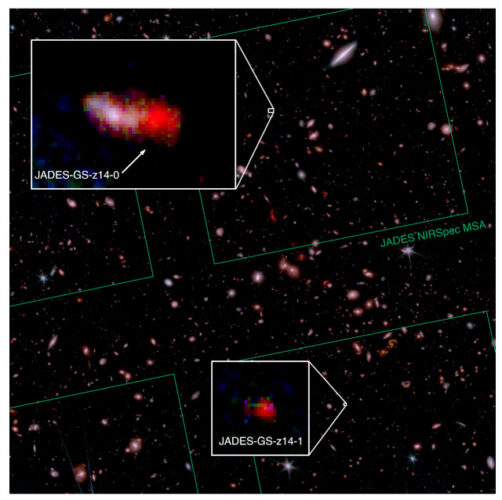
The JADES-Gs-z14-0 and JADES-Gs-z14-1 galaxies as seen by the James Webb Space Telescope, also zoomed in the insets

An article still in its peer-reviewed phase available in preview on the ArXiv server reports the identification of the primordial galaxies JADES-GS-z14-0 and JADES-GS-z14-1, which might be the most distant galaxies discovered so far. A team of researchers used observations conducted with the James Webb Space Telescope as part of the JWST Advanced Deep Extragalactic Survey (JADES) program to identify hundreds of candidate galaxies dating back to the first 650 million years of universe life. If the estimates made are confirmed, we see JADES-GS-z14-0 as it was about 290 million years after the Big Bang and therefore it would be the oldest known.

The Earth and artistic concepts showing the exoplanet Gliese 12 b in possible versions ranging from no atmosphere to a very thick atmosphere like that of Venus

Two articles, one published in the journal “Monthly Notices of the Royal Astronomical Society” and one in “The Astrophysical Journal Letters”, report independent confirmations of the discovery of the exoplanet Gliese 12 b, which has a size very close to the Earth’s but orbits a red dwarf that has a mass and size that are around a quarter of the Sun’s. Two teams of researchers used observations conducted by NASA’s TESS space telescope and confirmations obtained with other instruments to verify the existence of Gliese 12 b. The available information doesn’t reveal if it has an atmosphere but several factors make it a good candidate for a follow-up search with the James Webb Space Telescope.

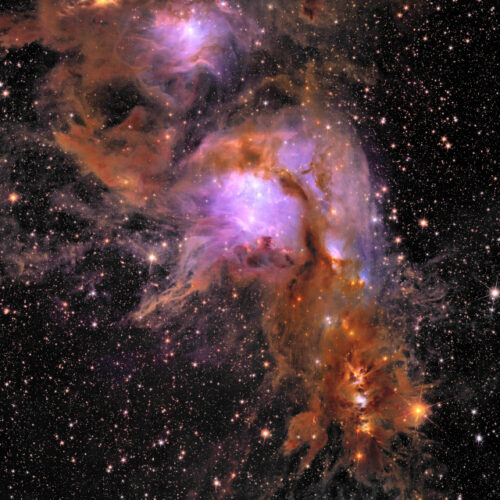
Messier 78 (ESA/Euclid/Euclid Consortium/NASA, image processing by J.-C. Cuillandre (CEA Paris-Saclay), G. Anselmi)

ESA and the Euclid Consortium have presented the first scientific results obtained thanks to the Euclid Space Telescope within the ERO (Early Release Observations) program. That’s a series of scientific articles partly written directly by the Consortium’s researchers and partly by different teams of researchers who worked within the ERO program. Some images illustrate the possibilities of this instrument but research into some of the major cosmological mysteries goes far beyond the aesthetics of photos.

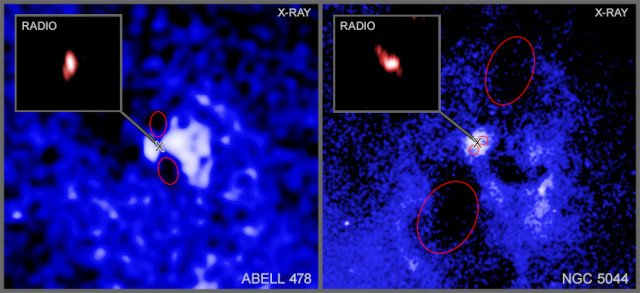
The galaxies Abell 478 and NGC 5044 seen in X-rays by the Chandra Observatory with data detected at radio waves by the VLBA (Very Large Baseline Array) radio telescope zoomed in the insets

An article published in “The Astrophysical Journal” reports a study of supermassive black holes that emit jets of energy that are aimed in different directions over time. A team of researchers led by Francesco Ubertosi of the University of Bologna, Italy, combined observations conducted with NASA’s Chandra X-ray Observatory and the VLBA radio telescope to examine 16 galaxies finding that about a third of their supermassive black holes emit jets that changed direction significantly within the last 10 million years. For this type of emission, they were compared to the Death Star.