Astronomy / Astrophysics

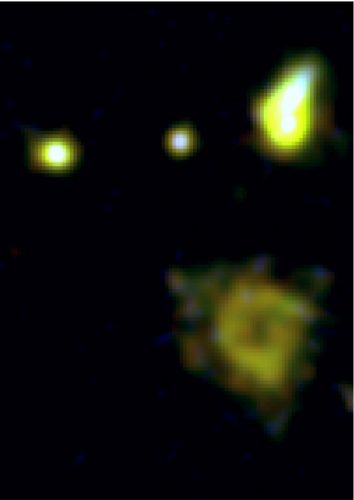
Galaxy R5519 (Image courtesy Tiantian Yuan/Hubble Space Telescope)

An article published in the journal “Nature Astronomy” reports the study of a very rare type of galaxy, called a cosmic ring of fire. A team of researchers led by Dr. Tiantian Yuan from Australia’s ARC Centre of Excellence for All Sky Astrophysics in 3 Dimensions (ASTRO 3D) used spectroscopic images obtained at the Keck Observatory in Hawaii and images captured by the Hubble Space Telescope to identify the strange structure of the galaxy officially designated as R5519. It’s an ancient galaxy, and its discovery may require new changes to current galactic formation models.

Wolfe Disk seen by ALMA

An article published in the journal “Nature” reports a study on the galaxy nicknamed Wolfe Disk that shows that it formed very early, to the point that it already had the shape of a disk galaxy about 1.5 billion years after the Big Bang. A team of researchers used the ALMA radio telescope to study this galaxy and find evidence of its characteristics that make it the oldest with a rotating disk found so far. Its existence so early in the history of the universe poses a problem for the current galactic formation models.

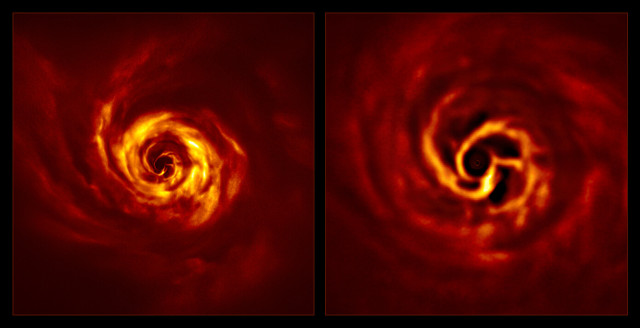
The AB Aurigae system seen by SPHERE

An article published in the journal “Astronomy & Astrophysics” reports evidence of the existence of a planet in formation in the protoplanetary disk surrounding the young star AB Aurigae. A team of researchers led by Anthony Boccaletti, of the Observatoire de Paris, PSL University, France, used the SPHERE instrument mounted on ESO’s VLT in Chile to find traces of what could be a planet. SPHERE takes real photos of the objects, so if the discovery was confirmed it would be the first direct evidence of a planet seen while it’s forming.

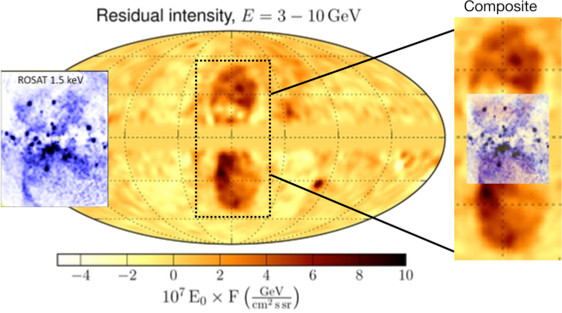
Gamma-ray and X-ray observations of the center of the Milky Way

An article published in “The Astrophysical Journal” offers an explanation of the origin of the so-called Fermi bubbles, the two gigantic gas bubbles existing above and below the center of the Milky Way. Guo Fulai and Zhang Ruiyu of the Shanghai Astronomical Observatory (SHAO) of the Chinese Academy of Sciences conducted a series of simulations that allowed to create a model that explains the origin of the Fermi bubbles and at the same time of the biconical X-ray structure at the center of the galaxy. According to the new model, the two phenomena are caused by shock waves generated by two jets from Sagittarius A*, or simply Sgr A*, the supermassive black hole at the center of the Milky Way, around 5 million years ago.

Artist's concept of the TRAPPIST-1 system (Image courtesy NAOJ)

An article published in “The Astrophysical Journal Letters” reports a study on the alignment of the ultra-cool dwarf star TRAPPIST-1 with its system’s 7 planets. A team of researchers led by Teruyuki Hirano of the Tokyo Institute of Technology used the Subaru telescope on Mount Mauna Kea, Hawaii, to observe that system not finding a significant misalignment of the planets with respect to their star. The astronomers who conducted the study warn that the measurements’ accuracy is not enough to completely rule out a small misalignment, but the result is significant in the study of the evolution of very small stars’ planetary systems.