Astronomy / Astrophysics

Asteroid Hygiea is spherical and could be reclassified as a dwarf planet

An article published in the journal “Nature Astronomy” reports a study of asteroid Hygiea that shows its roughly spherical shape, one of the requirements to be cataloged as a dwarf planet. A team of researchers led by Pierre Vernazza of the Laboratoire d’Astrophysique of Marseille, France, used the SPHERE instrument mounted on ESO’s VLT in Chile to obtain detailed images of one of the largest objects in the asteroid belt between Mars and Jupiter. If Hygiea were reclassified, it would be the smallest dwarf planet with a diameter that is less than half that of Ceres.

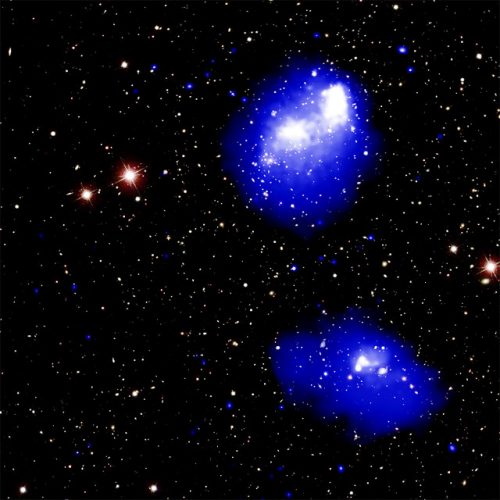
A map of the four galaxy clusters merging in Abell 1758

An article published in “The Astrophysical Journal” reports a study on Abell 1758, a quadruple galaxy cluster formed by two pairs that are in different merger phases. A team of researchers used NASA’s Chandra X-ray Observatory and other telescopes to map this gigantic group of galaxies. Each pair is made up of hundreds of galaxies embedded in enormous amounts of hot gas and invisible dark matter. These accurate observations will help to better assess how long it will take for mergers to occur in the two pairs of clusters, which in the future will in turn merge to form a super cluster that will be one of the most massive objects in the universe.

Artist's concept of a planetary collision in the BD +20 307 system (Image NASA/SOFIA/Lynette Cook)

An article published in “The Astrophysical Journal” reports a study of the BD +20 307 binary system in which the presence of dust too warm to be the equivalent of the Kuiper belt was detected, therefore they have been interpreted as the remains of a planetary collision. A team of researchers led by Maggie Thompson of the University of California at Santa Cruz used the SOFIA flying telescope to detect infrared emissions, which increased over time.

Titan's dunes (Image courtesy University of Hawaii at Manoa)

An article published in the journal “Science Advances” reports a study that offers some answers to the mystery of the origin and composition of the dunes on Titan, one of the moons of the planet Saturn particularly interesting for many reasons that include the formation of many organic compounds. A team of researchers led by physical chemist Ralf I. Kaiser of the University of Hawaii at Manoa examined data collected during the Cassini-Huygens mission and computer simulations whose results indicate that acetylene exposed to cosmic rays can form materials that make up Titan’s dunes.

Artist's concept of MAXI J1820+070's system (Image courtesy John Paice)

An article published in the journal “Monthly Notices of the Royal Astronomical Society” reports a study of the black hole MAXI J1820+070, part of an X-ray binary system that includes a normal star to which the black hole steals gas. A team of astronomers coordinated by the British University of Southampton used the HiPERCAM and NICER instruments to detect visible light and X-rays respectively emitted during an outburst activity in 2018. The data collected were used to create a video slowed down ten times to allow astronomers to see the fastest flares and examine the details of that activity.