Astronomy / Astrophysics

Artist's concept of a quasar (Image ESO/M. Kornmesser)

An article published in the journal “Astronomy & Astrophysics” reports an analysis of 48 quasars in the early universe to detect the outflows of materials they produce. A team of researchers led by Manuela Bischetti of the Italian National Institute of Astrophysics in Rome used the ALMA radio telescope to confirm for the first time the common existence of those outflows, which act as powerful winds inside those early galaxies heavily interfering in the formation of new stars.

Two disks that rotate in opposite directions around the supermassive black hole at the center of the galaxy NGC 1068

An article published in the journal “The Astrophysical Journal” reports the discovery of a supermassive black hole at the center of the galaxy NGC 1068 surrounded by two gas disks that rotate in opposite directions. A team of researchers led by Caterina Maria Violette Impellizzeri of the National Radio Astronomy Observatory (NRAO) used the ALMA radio telescope to observe the center of that galaxy in sufficient detail to detect the two disks and their motions. That situation is not very stable and in the future a collision between the two rings could generate an abundant meal for the black hole. That’s a possible quick growth mechanism for supermassive black holes.

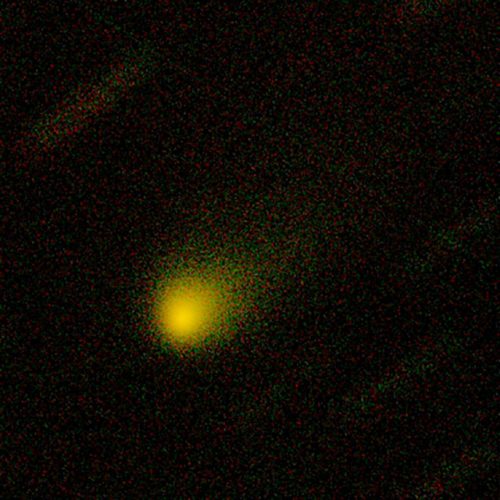
Interstellar comet 2I/Borisov (Image courtesy Gemini Observatory/Nsf/Aura)

An article published in the journal “Nature Astronomy” reports an initial characterization of interstellar comet 2I/Borisov, initially designated as C/2019 Q4. A team of researchers used data collected using the Gemini North on the island of Mauna Kea, in Hawaii, and the William Herschel Telescope in the Canaries. The data confirm it comes from another star system, yet it has characteristics very similar to the comets of the solar system.

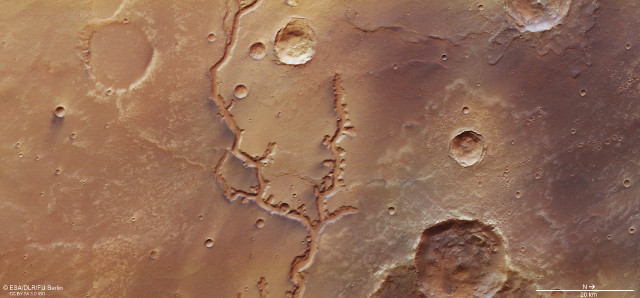
Nirgal Vallis on Mars (Image ESA/DLR/FU Berlin, CC BY-SA 3.0 IGO)

ESA has released new images captured by its Mars Express space probe’s High Resolution Stereo Camera (HRSC) showing Nirgal Vallis on the planet Mars. It’s a river valley that extends for over 700 kilometers, so vast that it crosses the Coprates and Margaritifer Sinus quadrangles. A few billion years ago, when the rivers were filled with liquid water, they probably filled Holden Crater, making it a lake with a diameter of about 150 kilometers and a depth of up to about 250 meters.

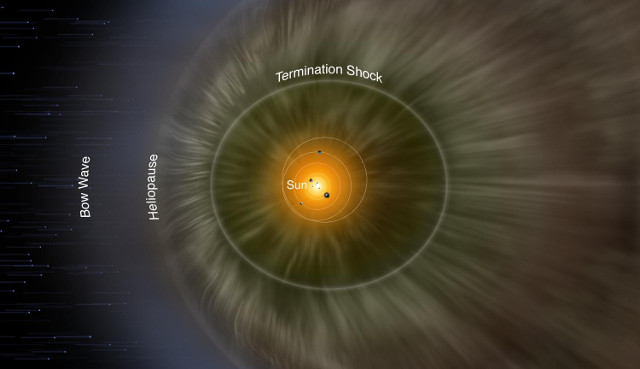
Illustration of the heliosphere (Image NASA/IBEX/Adler Planetarium)

A team of scientists led by Jamie Rankin of Princeton used measurements of the galactic cosmic rays detected by NASA’s Voyager space probes to obtain an estimate of the total pressure that plasma, magnetic fields and various particles exert on each other in the heliosheath, the outer region of the heliosphere, the big bubble around the Sun where solar wind exerts its influence. The result is higher than expected and will help to better understand the interactions between the Sun and its surroundings.