Astronomy / Astrophysics

Filaments (in blue) that connect the galaxies (in white) of the SSA22 cluster (Image courtesy Hideki Umehata)

An article published in the journal “Science” reports the discovery of massive gas filaments between the galaxies of a protocluster cataloged as SSA22 about 12 billion light years from Earth. A team of researchers coordinated by the RIKEN Cluster for Pioneering Research used the MUSE spectrograph mounted on the VLT in Chile and the Suprime-Cam on the Subaru telescope to map those filaments, which extend over more than 3 million light years. Follow-up observations that provided further details were conducted with the ALMA radio telescope and the Keck telescope. The filament gas can feed star formation and the growth of supermassive black holes in the protocluster. The observation of those processes can provide new information on the evolution of galaxies.

New organic compounds discovered on Saturn's moon Enceladus

An article published in the journal “Monthly Notices of the Royal Astronomical Society” reports the identification of organic compounds on Enceladus, the moon of Saturn which became famous in the last decade after the discovery of an underground ocean. A team of researchers led by Nozair Khawaja used data collected by the Cassini space probe’s Cosmic Dust Analyzer (CDA) to identify compounds that could be (di)methylamine, ethylamine and carbonyls in ice grains from the surface of Enceladus. They aren’t the first organic compounds that are formed on Enceladus and represent another interesting discovery in the search for life forms on that moon.

The protocluster z66OD with its galaxies in the insets (Image courtesy NAOJ/Harikane et al.)

An article published in “The Astrophysical Journal” reports the discovery of a galaxy protocluster dating back to about 13 billion years ago. A team of astronomers led by Yuichi Harikane of the National Astronomical Observatory of Japan (NAOJ), used the Subaru, Keck and Gemini telescopes to find a group of 12 early galaxies including a giant one nicknamed Himiko that form a precursor of today’s galaxy clusters cataloged as z66OD. Its study will help to better understand the evolution of these cosmic structures and the influences among the galaxies that form them, especially the more massive ones.

Artist's concept of tidal destruction event (Image NASA's Goddard Space Flight Center)

An article published in “The Astrophysical Journal” reports the study of an event cataloged as ASASSN-19bt in which a supermassive black hole destroyed a star that came too close to it. A team of researchers led by Patrick Vallely and Tom Holoien discovered the start of the event thanks to the ASAS-SN network, obtained observations thanks to the NASA TESS space telescope, which was aimed at that area, and conducted follow-up observations using NASA’s Swift and ESA’s XMM-Newton space telescopes and the network of ground-based Las Cumbres Observatories.

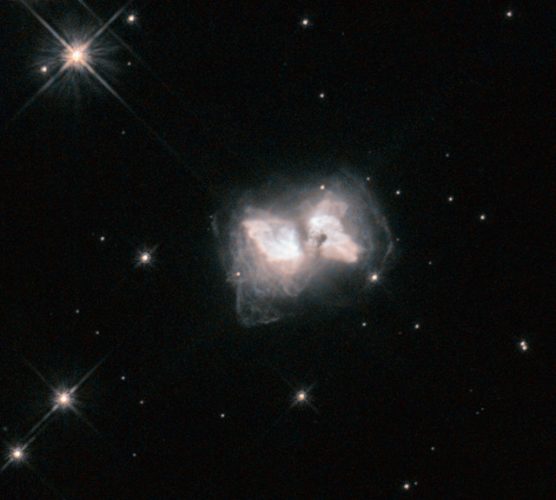
The AFGL 4104, or Roberts 22, protoplanetary nebula (Image NASA, ESA, and R. Sahai (Jet Propulsion Laboratory))

An article published in the journal “Monthly Notices of the Royal Astronomical Society” reports a study on the importance of the ejection of materials by stars in the last stages of their life in the formation of life forms such as those on the Earth. Professor Michael Smith and PhD student Igor Novikov of the British University of Kent performed a series of computer simulations of processes in protoplanetary nebulae obtaining results that offer important clues concerning the recycling of materials generated in stars and ejected into interstellar space.