Astronomy / Astrophysics

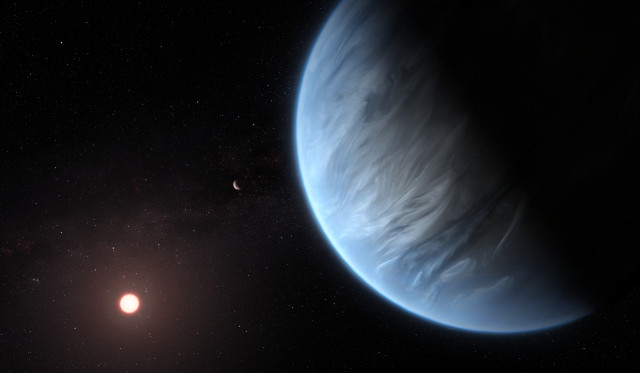
Artist's concept of K2-18b with its star in the background (Image ESA/Hubble, M. Kornmesser)

An article published in the journal “Nature Astronomy” reports the detection of water vapor in the exoplanet K2-18b’s atmosphere mainly thanks to the Hubble space telescope. This exoplanet is in ​​its system’s habitable zone and this made it interesting since this super-Earth was discovered in 2015. It’s the first detection of water vapor in an exoplanet of that type but it’s still too soon to assess its habitability potential because the detections are not precise enough to define the percentages of other molecules such as hydrogen and helium and to understand if there are clouds.

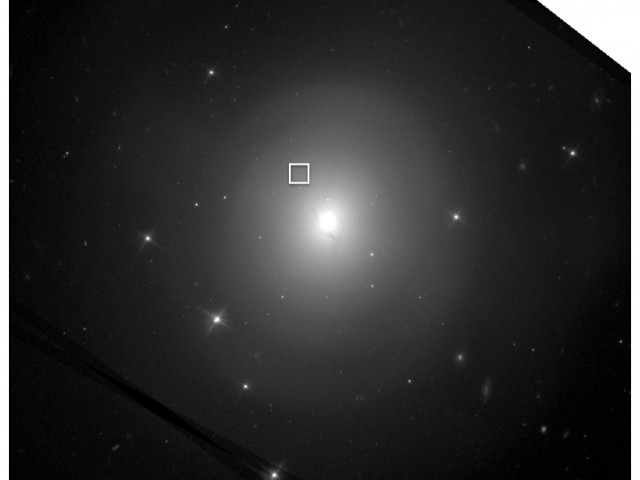
The afterglow of the event GW170817 in the inset (Image courtesy Wen-fai Fong/Northwestern University)

An article accepted for publication in “The Astrophysical Journal Letters” reports the results of the search for the afterglow of the merger between two neutron stars identified two years ago and cataloged as GW170817. It made history because it’s the first event of that type identified and was observed at both gravitational waves and electromagnetic waves. A team of researchers led by Wen-fai Fong of Northwestern University used the Hubble space telescope to detect the now very dim afterglow, the residual radiation after months of strong emissions.

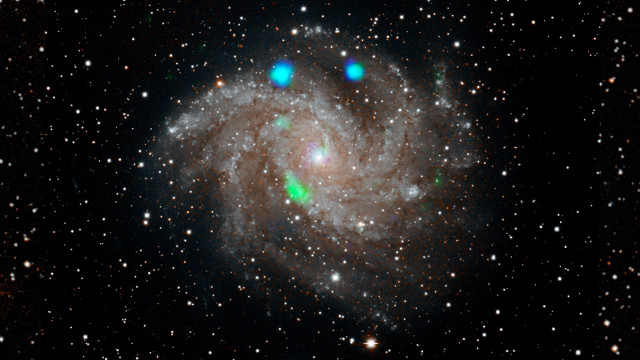
The galaxy NGC 6946 and its ULXs (Image NASA/JPL-Caltech)

An article published in “The Astrophysical Journal” reports a study on some ultraluminous X-ray sources observed in the galaxy NGC 6946. A team of researchers led by Hannah Earnshaw, a postdoctoral researcher at Caltech, used observations carried out with NASA’s NuSTAR space telescope of. In particular, their interest focused on one of the sources, cataloged as ULX-4, also observed with ESA’s XMM-Newton space telescope but after ten days NASA’s Chandra X-ray Observatory found no more traces of it. Such an event usually has a long duration so it could have been generated by a black hole or a neutron star on nearby debris.

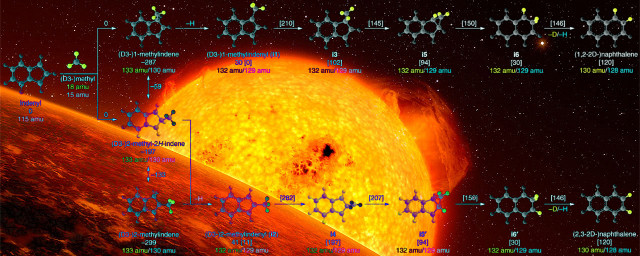
Life's building blocks can be formed from free radicals generated in space

An article published in the journal “Nature Communications” reports the discovery of a new method to form the organic compounds of the polycyclic aromatic hydrocarbon (PAH) group in space. A team of researchers at the Berkeley National Laboratory found what in jargon is called a pathway to get to the formation of PAHs such as naphthalene from simpler molecules. These compounds are important in the formation of amino acids, the building blocks of large biological molecules.

The star GJ 1061 (Image courtesy Centre de Données astronomiques de Strasbourg / SIMBAD / SDSS)

An article being published in the journal “Monthly Notices of the Royal Astronomical Society” reports the discovery of three super-Earths in the system of the red dwarf star GJ 1061. A team of astronomers from the Red Dots collaboration made this discovery during the 2018 observation campaign thanks to a series of spectroscopic detections obtained over three months using the radial velocity method. The masses of these exoplanets are a bit higher than the Earth’s and the outermost is in ​​its system’s habitable zone, where it receives an amount of energy from its star close to what the Earth receives from the Sun.