Astronomy / Astrophysics

Artistic representation of a gaseous planet in a binary system (Image NASA/JPL-Caltech/T. Pyle)

An article published in “The Astrophysical Journal Letters” reports the discovery of a gaseous exoplanet in the DS Tuc binary system thanks to the use of NASA’s TESS space telescope. A team of astronomers coordinated by Dartmouth College, New Hampshire, USA, conducted this research on the exoplanet named DS Tuc Ab, which has an estimated age of about 45 million years, a sort of preteen. It has completed its growth but it’s still in a phase in which changes take place, all useful information to understand the formation and evolution of the planets.

LTT 1445 aka LTT 1445ABC (Image NASA / ESA / Hubble)

An article to be published in “The Astronomical Journal” reports the discovery of a super-Earth that was cataloged as LTT 1445Ab thanks to NASA’s TESS space telescope in a research coordinated by the Harvard-Smithsonian Center for Astrophysics. This exoplanet orbits a red dwarf and from the estimates seem too close to it to have the potential to host life forms similar to the Earth’s but it’s interesting because that star has two companions, red dwarfs as well, and orbits them.

Using red giants to estimate the speed of the universe expansion

An article being published in “The Astrophysical Journal” reports a new attempt to calculate the speed of the universe expansion, this time using red giant stars as a reference. A team of researchers coordinated by Carnegie Institution for Science and University of Chicago and led by astronomer Wendy Freedman used observations made with the Hubble space telescope to perform that calculation. The result has a probability peak at 69.8 km/s per megaparsec, between the values ​​calculated using the two methods that provided discrepant values.

An explanation for the scarce presence of gold and other rare elements on the Moon

An article published in the journal “Nature” offers a possible explanation of the remarkable difference in the presence of some chemical elements on the Earth and on the Moon still accepting the theory of their common origin following an impact with the primordial Earth. A team of researchers carried out a series of simulations of the impacts that could have happened on the Moon during the first phase of its history, concluding that the retention of the elements classified as highly siderophilous began 4.35 billion years ago, at the time when most of the magma that covered the lunar surface solidified.

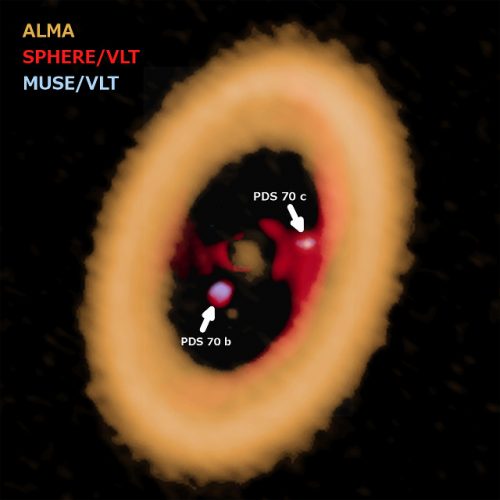
Possible moons in formation around the exoplanet PDS 70 c

An article published in the journal “The Astrophysical Journal Letters” reports the observation of what is interpreted as a circumplanetary disk in the system of the young star PDS 70. A team of researchers led by Andrea Isella of Rice University in Houston, Texas, used the ALMA radio telescope to detect the emissions of that disk that surrounds the exoplanet PDS 70 c and according to the astronomers is of the type that controls the formation of planets and of a system of moons such as those around the planet Jupiter.