Astronomy / Astrophysics

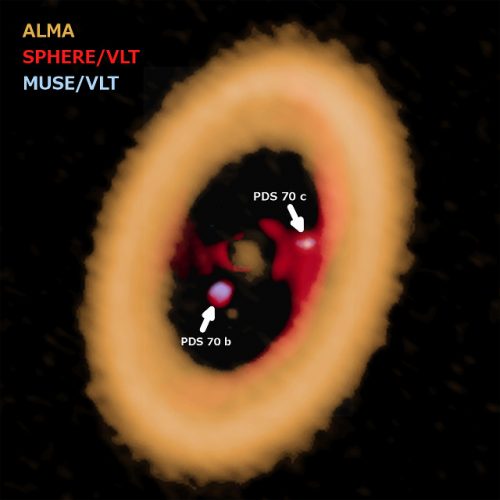
Possible moons in formation around the exoplanet PDS 70 c

An article published in the journal “The Astrophysical Journal Letters” reports the observation of what is interpreted as a circumplanetary disk in the system of the young star PDS 70. A team of researchers led by Andrea Isella of Rice University in Houston, Texas, used the ALMA radio telescope to detect the emissions of that disk that surrounds the exoplanet PDS 70 c and according to the astronomers is of the type that controls the formation of planets and of a system of moons such as those around the planet Jupiter.

The Spektr-RG space telescope blasting off atop a Proton rocket (Image courtesy Roscosmos)

A little more than two hours ago, the Spektr-RG space telescope was launched on a Proton rocket from the Baikonur Cosmodrome, Kazakhstan. After about two hours it separated from the rocket’s upper stage to head towards the L2 Lagrangian point, about 1.5 million kilometers from Earth.

The Spektr-RG (Spektr-Roentgen Gamma, SRG) space telescope is a project born from a collaboration of the Russian Roscosmos and German DLR space agencies for the observation of the X-ray sky. This type of astronomy got a bit crippled by the very premature end of the Japanese Hitomi mission while ESA’s XMM-Newton and NASA’s Chandra space telescopes are still active but these are missions that started twenty years ago.

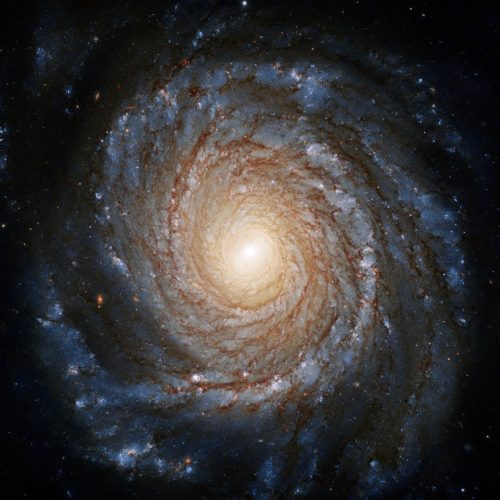
Galaxy NGC 3147 (Image ESA/Hubble & NASA, A. Riess et al.)

An article published in the journal “Monthly Notices of the Royal Astronomical Society: Letters” reports a study on a supermassive black hole surrounded by a disk of materials that revealed unexpected features. A team of researchers led by Stefano Bianchi, of the University of Roma Tre, Italy, used the Hubble Space Telescope to observe the nucleus of the galaxy NGC 3147 discovering a small and soft disk, a reduced version of the large disks typical of active galactic nuclei, a structure that shouldn’t exist. The discovery represents a new opportunity to test some relativistic effects but could force astronomers to review certain models on active galactic nuclei.

Photo of asteroid Ryugu's soil taken by the ONC-W1 camera (Photo courtesy JAXA. All rights reserved)

A few hours ago the Japanese space probe Hayabusa 2 touched down on the soil of asteroid Ryugu to collect some subsurface samples that will be transported to Earth. This is the second attempt of the three possible at the start of the mission. After the first sample taken on February 22, 2019, the Japanese space agency JAXA decided to proceed with a second attempt in another area to then finish Ryugu’s study and return to Earth with the samples taken.

Using neutron star mergers to estimate the speed of the universe expansion

An article published in the journal “Nature Astronomy” reports the use of observations of the neutron stars merger recorded on August 17, 2017 to try to calculate the value of the Hubble constant, which measures the speed of the universe expansion. That event is the most famous of those recorded so far for gravitational waves due to the importance it had for the so-called multimessenger astronomy but it has already proved useful also to offer an additional way to measure the expansion of the universe that is alternative to the two that are providing a discrepancy in their results.