Astronomy / Astrophysics

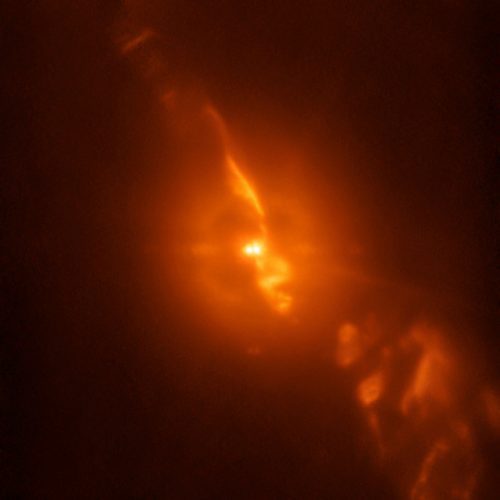
R Aquarii (Image ESO/Schmid et al.)

An article published in the journal “Astronomy & Astrophysics” describes a new observation of the R Aquarii binary system, consisting of a red giant of the type called Mira variable and a white dwarf. A team of researchers used that pair of stars as a target for a test of a new subsystem of the SPHERE instrument mounted on ESO’s VLT obtaining the clearest image captured so far of the turbulence existing in the system due to the fact that the white dwarf is stealing gas from its companion, worsening its agony.

Asteroid Bennu (Image NASA/Goddard/University of Arizona)

NASA has announced that its OSIRIS-REx space probe has found traces of water in the asteroid Bennu, reached on December 3. This is water bound to minerals present on Bennu’s surface, hydrated silicates formed in the very early stages of the solar system’s history, when the first small bodies such as the asteroids started forming.

Representation of the heliosphere with the Voyagers (Image NASA/JPL-Caltech)

NASA has confirmed that its Voyager 2 space probe has entered interstellar space. The instruments still operating confirmed that it passed through the outer boundary of the heliosphere, called heliopause, where the influence of solar wind ends meeting interstellar particles. These results were presented by members of the Voyager mission team today at the meeting of the American Geophysical Union (AGU) being held in Washington these days.

Planetary formation discovered in the Taurus molecular cloud

An article published in the journal “The Astrophysical Journal” reports the observation of structures in protoplanetary disks that probably were left by newborn and perhaps still developing planets. A team of researchers led by Feng Long of the University of Beijing used the ALMA radio telescope to examine disks surrounding young stars in the Taurus star formation region discovering that of 32 protoplanetary disks 12 were divided into rings, a situation associated with planetary formation.

A catalog of gravitational wave detections includes 4 new events

Two articles published on the arXiv server show a catalog of gravitational wave events detected by the LIGO and Virgo collaborations and the inferred properties concerning the black hole pairs discovered in the mergers. So far, 7 events were announced but the analysis of the data led to the discovery of 4 more events of which one was detected by Virgo as well. Of the 11 now known, there’s the one that became famous because it was generated by two neutron stars that led to a kilonova while the other 10 were generated by black hole pairs.