Astronomy / Astrophysics

A graph with the conservative habitable zone illustrated by the orange band and ellipses illustrating the extended habitable zone proposed by this study

An article published in “The Astrophysical Journal” reports the results of a study on the habitable zone that goes beyond the so-called conservative zone because it’s based on rigid assumptions. Astrophysicist Amri Wandel of the Hebrew University of Jerusalem focused on examining the conditions existing in systems of low-mass stars: orange dwarfs (K-class stars) and red dwarfs (M-class stars). The study specifically considered planets tidally locked to their stars.

Amri Wandel conducted an analysis using climate models that account for global heat transport, the greenhouse effect, and albedo. This led him to conclude that these stars may host planets potentially habitable for Earth-like life forms orbiting outside the conservative habitable zone.

A Falcon 9 rocket lifting off on the Twilight rideshare mission (Image courtesy SpaceX)

A few hours ago, a Falcon 9 rocket launched from Vandenberg Air Force Base on the Twilight rideshare mission, carrying a total of 40 satellites in various phases. About two hours and twenty minutes after launch, the final group of satellites was deployed by SpaceX’s system. Among them were NASA’s Pandora Space Telescope and the BlackCAT and SPARCS nanosatellites, both 30x20x10-centimeter CubeSat-class satellites, part of NASA’s CubeSat Launch Initiative. These satellites will conduct their astronomical observations from low-Earth orbit.

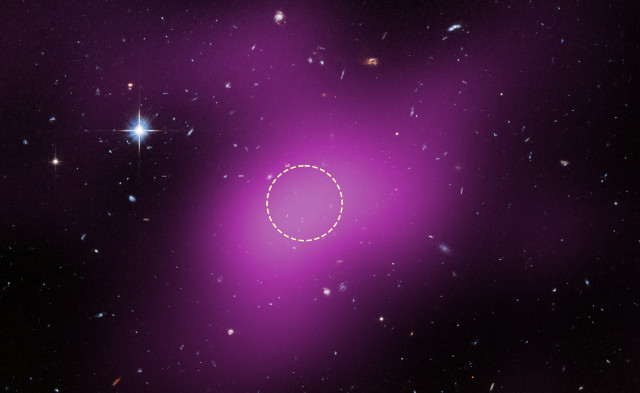
The location of Cloud-9 (Image NASA, ESA. G. Anand (STScI), and A. Benitez-Llambay (Univ. of Milan-Bicocca); Image processing: J. DePasquale (STScI))

An article published in “The Astrophysical Journal Letters” reports the discovery of what was dubbed Cloud-9, which can be described as a failed galaxy. A team of astronomers used observations with the FAST radio telescope to identify what appears to be a new type of astronomical object, and follow-up observations with the Hubble Space Telescope, the Green Bank Telescope (GBT), and the Very Large Array (VLA) to confirm the existence of the first object of its kind that was identified with reasonable certainty.

Technically defined as a reionization-limited H i cloud (RELHIC), Cloud-9 is a starless gas cloud that is supposed to be composed of dark matter filled with hydrostatic gas in thermal equilibrium with the cosmic ultraviolet background. Cloud-9 will help test cosmological models regarding dark matter.

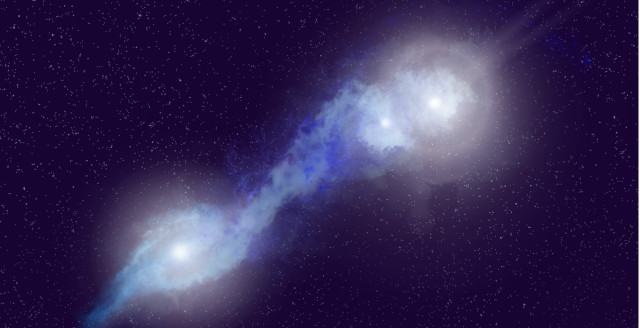
Artist's impression of the J1218/1219+1035 system (Image NSF/AUI/NSF NRAO/P. Vosteen)

A rare example of three active galactic nuclei in three merging galaxies has been discovered using two radio telescopes: the VLA and the VLBA. The triple system, approximately 1.2 billion light-years from Earth, is cataloged as J1218/1219+1035. This targeted study, conducted by a team of researchers at various radio frequencies, has identified only the third case of a triple active galactic nucleus, the first confirmed through radio observations. This discovery is useful for better understanding certain galaxy merger processes, such as the ones that led to the formation of the Milky Way.

The complete map obtained thanks to the SPHEREx space telescope, with infrared emissions generated mainly by dust (red) and hot gas (blue), key ingredients in the formation of new stars and planets

NASA has published the first cosmic map generated using observations from its SPHEREx space telescope. In particular, these observations include 102 wavelengths in the near-infrared. What NASA has defined as 102 colors offer a wealth of different information about the observed objects, valuable in a variety of cosmological studies. The wealth of information is such that NASA treats them as if they had obtained 102 different maps.