Astronomy / Astrophysics

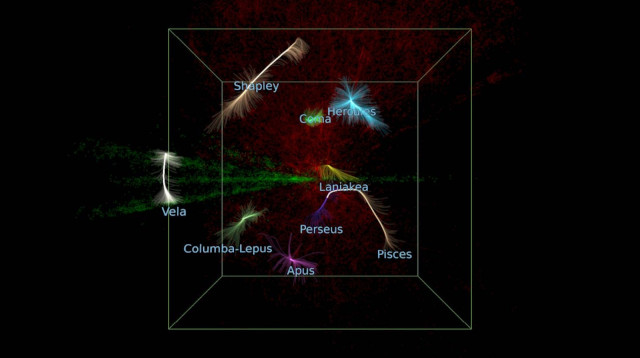
The complete map obtained thanks to the SPHEREx space telescope, with infrared emissions generated mainly by dust (red) and hot gas (blue), key ingredients in the formation of new stars and planets

NASA has published the first cosmic map generated using observations from its SPHEREx space telescope. In particular, these observations include 102 wavelengths in the near-infrared. What NASA has defined as 102 colors offer a wealth of different information about the observed objects, valuable in a variety of cosmological studies. The wealth of information is such that NASA treats them as if they had obtained 102 different maps.

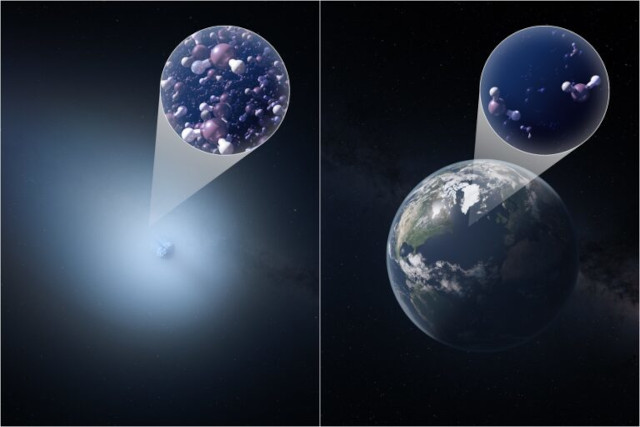
Artist's concept of the of the exoplanet PSR J2322-2650b and its pulsar (Image NASA, ESA, CSA, Ralf Crawford (STScI))

An article published in The Astrophysical Journal Letters reports the results of a study of a gas giant exoplanet cataloged as PSR J2322-2650b, which has a completely abnormal atmosphere composed above all of helium and carbon. A team of researchers used observations conducted with the James Webb Space Telescope to study the atmosphere of this exoplanet, which has a mass similar to Jupiter’s and has a distance from its star that is only one-hundredth of the Earth’s distance from the Sun. The star is a pulsar, adding another unusual element to the system. PSR J2322-2650b can’t be explained by current models of planetary formation.

The ESCAPADE twin probes blasting off atop a New Glenn rocket (Image courtesy Blue Origin)

A few hours ago, NASA’s ESCAPADE (Escape and Plasma Acceleration and Dynamics Explorers) twin probes were launched atop a Blue Origin New Glenn rocket, which accomplished its mission, called NG-2. One goal for Blue Origin was to land the first stage, which was a successful one just over 9 minutes after launch. After approximately 33 minutes, the probes, named Blue and Gold, separated from the rocket’s second stage and began a long journey to Mars to study its magnetosphere and the Sun’s impact on the red planet.

Galaxy NGC 3621 with the location of supernova SN 2024ggi in the small circle

An article published in the journal “Science Advances” reports the first reconstruction ever of the shape of a Type II supernova in its early stages. A team of researchers led by Professor Yi Yang of Tsinghua University in Beijing, China, used observations conducted with ESO’s Very Large Telescope (VLT) in Chile to study the supernova cataloged as SN 2024ggi on April 11, 2024, the day after the explosion began.

The 4MOST instrument mounted on the VISTA telescope (Photo AIP/A. Saviauk)

On October 18, the 4-meter Multi-Object Spectroscopic Telescope (4MOST), mounted on ESO’s VISTA telescope in Chile, saw its so-called first light in its initial observation tests. With its system made of 2,436 optical fibers, 4MOST can capture light from a field of view with a diameter of up to 2.5 degrees, which in practice translates to an area equivalent to 16 times the size of the full Moon. The light is directed into three spectrographs that divide it into color components in the visible light range, providing individual spectra. This will enable a cosmological survey encompassing 25 million objects in the first five years of its operation.