Astronomy / Astrophysics

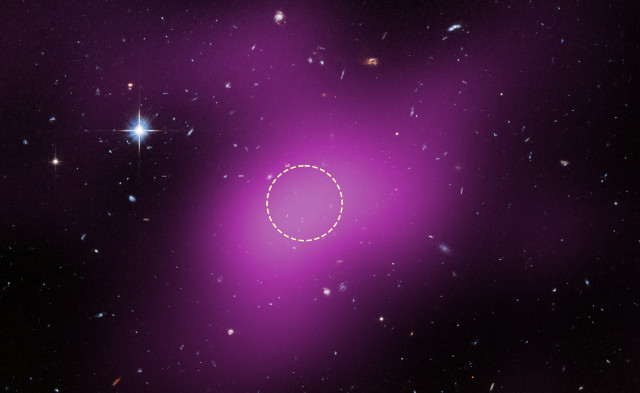
An optical-frequency image from the Legacy Surveys overlaid with radio emissions from the LoTSS survey, revealing the area of ​​the odd radio circle RAD J131346.9+500320

An article published in the journal “Monthly Notices of the Royal Astronomical Society” reports the discovery of three odd radio circles, including a pair cataloged as RAD J131346.9+500320. The discovery was made by examining data collected during the LOFAR Two-Metre Sky Survey (LoTSS) thanks to the collaboration of citizen scientists in the RAD@home program. A team of researchers examined these objects, and in particular, what appears to be a pair of intersecting rings, concluding that they’re the most distant discovered so far and that their emissions are the most powerful detected from these still poorly-known cosmic objects.

The cosmic wave in red and blue, with stars above the galactic disk in red and the ones below it in blue

An article published in the journal “Astronomy and Astrophysics” reports the results of a study that provides evidence that a sort of giant cosmic wave is crossing the Milky Way, propagating from the center outward from the galactic disk, causing a corrugation. A team of researchers led by Eloisa Poggio of the Italian National Institute for Astrophysics used data collected by ESA’s Gaia space probe to map the motions of thousands of young giant stars and Cepheids within the corrugation, reconstructing the wave that generates them. The cause may be the aftermath of an ancient collision with a dwarf galaxy, but follow-up studies are needed to assess this and other possible explanations.

The Carruthers Geocorona Observatory, IMAP (Interstellar Mapping and Acceleration Probe), and Space Weather Follow On-Lagrange 1 (SWFO-L1) space probe blasting off atop a Falcon 9 rocket (Image NASA+)

A little while ago, three space probes were launched atop a Falcon 9 rocket from the Kennedy Space Center. After approximately one hour and 23 minutes, they successfully separated from the rocket’s final stage within about 13 minutes and set off on a course that will take them to the area known as L1 (Lagrange 1), about 1.5 million kilometers from Earth, where they will begin their scientific work studying various aspects of space weather.

The Calvera pulsar and the diffuse emission region object of this study, seen in X-rays

An article published in the journal “Astronomy & Astrophysics” describes a candidate supernova remnant that was associated with the pulsar nicknamed Calvera. A team of researchers from the Italian National Institute for Astrophysics (INAF) and the University of Palermo, led by Emanuele Greco of INAF, conducted observations and analyses of a decidedly unusual pair, as finding it approximately 6,500 light-years above the Milky Way’s galactic plane was surprising.

An artist's impression of the UPM J1040βˆ’3551 AabBab system

An article published in the journal “Monthly Notices of the Royal Astronomical Society” (MNRAS) reports the discovery of a rare hierarchical quadruple system, which was cataloged as UPM J1040βˆ’3551 AabBab. A team of researchers used observations conducted with ESA’s Gaia space probe and NASA’s WISE space telescope, followed by spectroscopic detection and analysis, to identify this quartet consisting of a pair of red dwarfs and a pair of brown dwarfs. This relatively young system may offer new information, especially about brown dwarfs, objects halfway between planets and stars.