Astronomy / Astrophysics

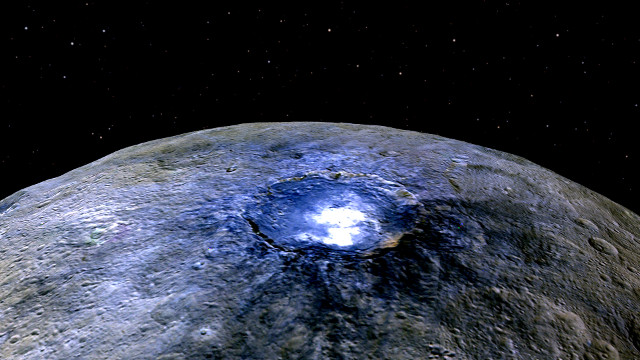
Occator Crater in falso colors stressing the white spots (Image NASA/JPL-Caltech/UCLA/MPS/DLR/IDA)

Two studies published in the journal “Nature” offered new interesting information about the dwarf planet Ceres. Thanks to analyzes of data collected by NASA’s Dawn space probe the authors of these studies claim that the mysterious white spots are composed of salts and that on Ceres there are ammonia-rich clays. The explanations about the materials that make up the white spots may solve a mystery while the presence of ammonia creates another, linked to the origin of this dwarf planet.

Artistic concept of the Akatsuki space probe orbiting Venus (Image courtesy JAXA. All rights reserved)

JAXA, the Japanese space agency, confirmed that its space probe Akatsuki has successfully accomplished the maneuvers to allow it to enter the orbit of the planet Venus. These maneuvers took place exactly five years after the failure of the first attempt. The orbit is significantly different from the one programmed for the mission and JAXA engineers are assessing it to schedule some additional maneuvers. However, there’s optimism about the possibility of carrying out the scientific mission Akatsuki was built for.

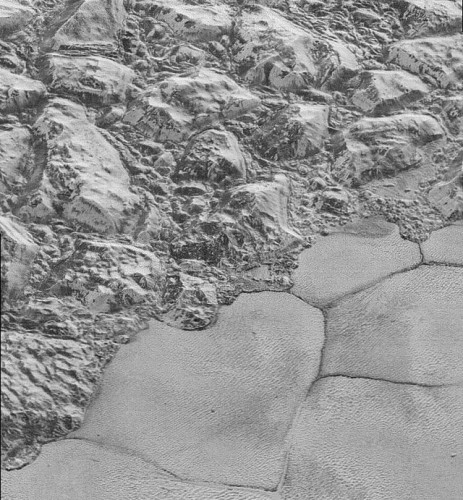
One of the very high resolution pictures of Sputnik Planum on Pluto (Image NASA/JHUAPL/SwRI)

NASA released the first very high resolution photographs showing close-ups of ​​the dwarf planet Pluto’s surface. These are images captured by the New Horizons space probe during its extraordinary July 14, 2015 flyby. In recent months, NASA already received high-resolution photographs but these ones are part of a series of shots that was intended to capture the details of Pluto’s surface, in this case the area called Sputnik Planum.

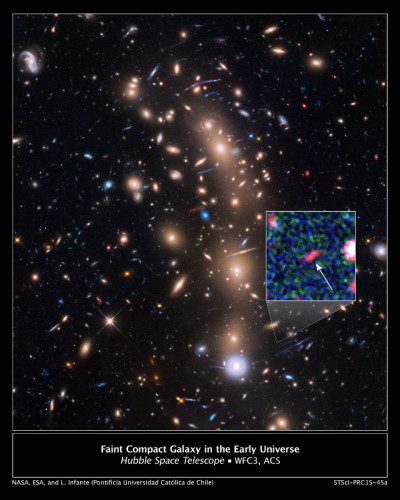
The galaxy cluster MACSJ0416.1-2403 observed by the Hubble Space Telescope with the galaxy nicknamed Tayna in the inset (Image NASA, ESA, and L. Infante (Pontificia Universidad Catolica de Chile))

An article published in the journal “Astrophysical Journal” describes the discovery of the faintest galaxy in the early universe. According to this study, this galaxy was born when the universe was “only” about 400 million years old and for this reason was nicknamed Tayna, which means “first born” in the Aymara language. To detect its light the gravitational lensing effect of a galaxy cluster was used. That allowed to capture the extremely dim light of a total of 22 ancient galaxies using the Hubble and Spitzer space telescopes.

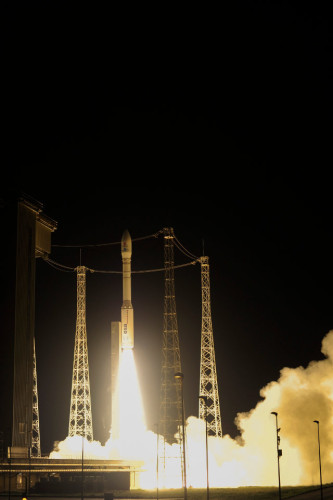
The LISA Pathfinder space probe blasting off atop a Vega rocket (Photo ESA–Stephane Corvaja)

A few hours ago ESA’s LISA Pathfinder space probe was successfully launched atop a Vega rocket from the Kourou space center in French Guiana. After about an hour and 45 minutes it separated from the rocket’s upper stage and activated to begin its long journey thanks to its propulsion module.

LISA Pathfinder entered an elliptical orbit where it will make a series of maneuvers that within a few weeks will take it to the area called L1, where the gravity of the Earth and the Sun get balanced with the other forces acting on the probe. The propulsion module will be disconnected after exhausting its function and the probe will remain in the L1 area, about 1.5 million kilometers (about 900,000 miles) from Earth.