Astronomy / Astrophysics

The galaxy NGC 6052 photographed by the Hubble Space Telescope (Image ESA/Hubble & NASA, Acknowledgement: Judy Schmidt)

NGC 6052 is a galaxy apparently abnormal because of its odd shape. It was initially classified in that way but later astronomers realized that it’s actually the result of an ongoing merger of two galaxies with similar masses. The Hubble space telescope was used to take a picture of NGC 6052 with its Wide Field Planetary Camera 2 (WFPC2), which includes observations in visible and ultraviolet light.

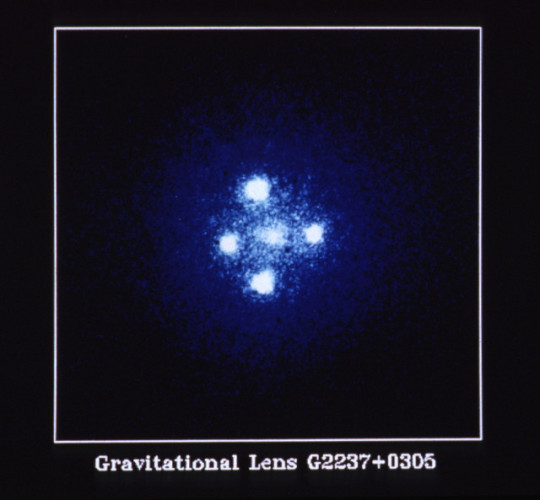
The quasar Q2237+0305 nicknamed Einstein Cross photographed by the Hubble Space Telescope (Image NASA, ESA, and STScI)

An article published in “The Astrophysical Journal Letters” describes a research on the quasar Q2237+0305 nicknamed Einstein Cross or Einstein’s Cross. Through the technique of gravitational microlensing a team of Spanish astrophysicists carried out the most accurate measures of the innermost region belonging to the disc of materials spinning around the supermassive black hole that feeds this quasar.

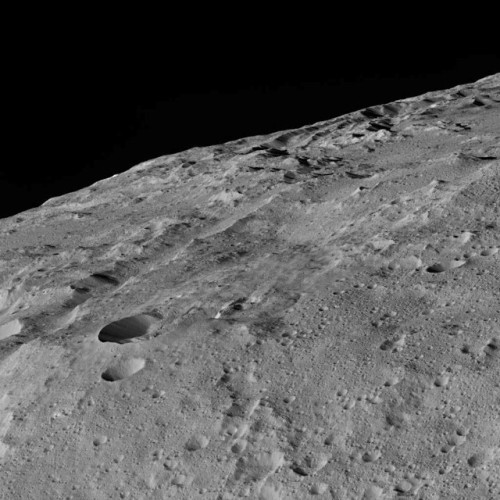
Picture of the area called Gerber Catena with its craters, depression and fractures (Image NASA/JPL-Caltech/UCLA/MPS/DLR/IDA)

Nearly three weeks ago NASA’s Dawn space probe reached its final orbit, at an altitude of about 380 kilometers (240 miles) over the dwarf planet Ceres. It will remain there indefinitely, meaning that it will keep that orbit until the end of its mission but at that point it won’t be moved. It’s its lowest orbit and from there Dawn immediately started taking the most detailed pictures and make new detections with its instruments.

Photo of Enceladus' northern region showing the contrast between its areas (Image NASA/JPL-Caltech/Space Science Institute)

Some days ago, the Cassini space probe completed its last Enceladus flyby. It’s a Saturn’s moon very interesting for the presence of an underground ocean of liquid water. This time, Cassini passed about 5,000 kilometers (about 3,100 miles) from Enceladus measuring the heat flow from inside it and taking more pictures of its icy surface.

Galaxy NGC 1068 seen by the Hubble Space Telescope. In the circle there's an artist concept of the doughnut of gas and dust surrounding the supermassive black hole at its center (ImageNASA/JPL-Caltech)

An article published in the journal “Monthly Notices of the Royal Astronomical Society letters” describes a research on the supermassive black hole at the center of the galaxy NGC 1068. An international team of astronomers led by Andrea Marinucci of the Roma Tre University in Italy used ESA’s XMM-Newton and NASA’s NuSTAR space telescopes to study the giant doughnut-shaped structure around the supermassive black hole.