Astronomy / Astrophysics

Image showing the observations of the supernova SN Refsdal. In the uppermost circle there's the possible observation happened in 1998, in the middle circe the 2015 observation and in the lowermost circle the 2014 observation

The Hubble Space Telescope allowed us to observe a supernova just during the explosion. This is due to the fact that its appearance was foretold. For the first time, the use of complex calculations related to the theory of relativity made it possible to capture the supernova nicknamed Refsdal when it exploded. It’s the first time such a feat was achieved by exploiting the gravitational lensing of that galaxy cluster MACS J1149.5 + 2223, which bent the light from that star showing the explosion several times in different areas of the sky.

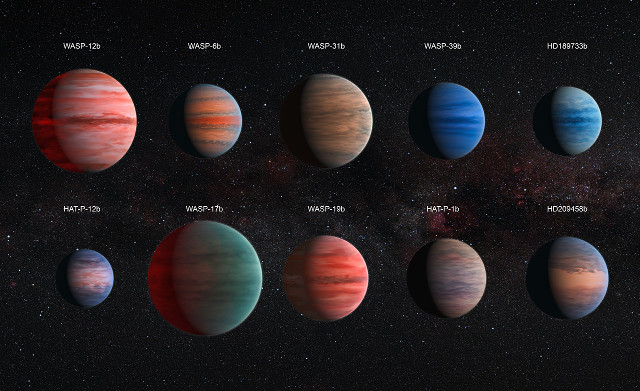
Artistic representation of the ten hot Jupiters examined in this research (Image NASA, ESA, and D. Sing (University of Exeter))

An article published in the journal “Nature” describes a research that provides an explanation to the apparent scarcity of water detected on some exoplanets of the type known as hot Jupiter. These are gas giants like Jupiter but orbit very close to their stars and consequently have very high surface temperatures. An international team of astronomers used the Hubble and Spitzer space telescopes to study ten exoplanets of this kind.

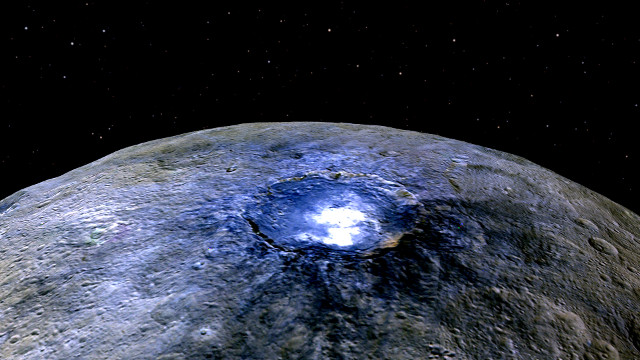
Occator Crater in falso colors stressing the white spots (Image NASA/JPL-Caltech/UCLA/MPS/DLR/IDA)

Two studies published in the journal “Nature” offered new interesting information about the dwarf planet Ceres. Thanks to analyzes of data collected by NASA’s Dawn space probe the authors of these studies claim that the mysterious white spots are composed of salts and that on Ceres there are ammonia-rich clays. The explanations about the materials that make up the white spots may solve a mystery while the presence of ammonia creates another, linked to the origin of this dwarf planet.

Artistic concept of the Akatsuki space probe orbiting Venus (Image courtesy JAXA. All rights reserved)

JAXA, the Japanese space agency, confirmed that its space probe Akatsuki has successfully accomplished the maneuvers to allow it to enter the orbit of the planet Venus. These maneuvers took place exactly five years after the failure of the first attempt. The orbit is significantly different from the one programmed for the mission and JAXA engineers are assessing it to schedule some additional maneuvers. However, there’s optimism about the possibility of carrying out the scientific mission Akatsuki was built for.

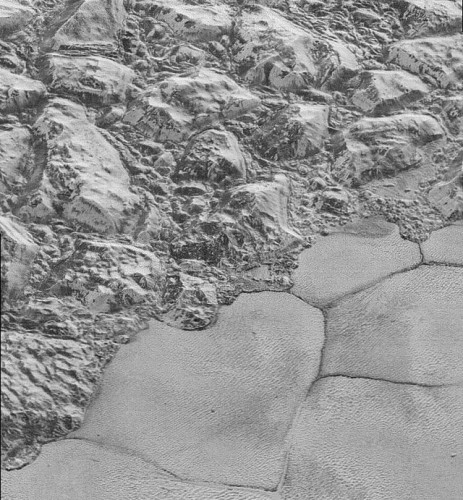
One of the very high resolution pictures of Sputnik Planum on Pluto (Image NASA/JHUAPL/SwRI)

NASA released the first very high resolution photographs showing close-ups of ​​the dwarf planet Pluto’s surface. These are images captured by the New Horizons space probe during its extraordinary July 14, 2015 flyby. In recent months, NASA already received high-resolution photographs but these ones are part of a series of shots that was intended to capture the details of Pluto’s surface, in this case the area called Sputnik Planum.