
Astronomy / Astrophysics

Pictures of Phobos showing the grooves on its surface (Photo NASA/JPL-Caltech/University of Arizona)

At the 47th Annual Meeting of the American Astronomical Society’s Division for Planetary Sciences in National Harbor, Maryland, A research was presented about Phobos, a moon of Mars. Terry Hurford of NASA’s Goddard Space Flight Center led a team of scientists who analyzed the grooves on Phobos surface. The conclusion is that these are the first signs of structural failure that will lead to the destruction of this moon.

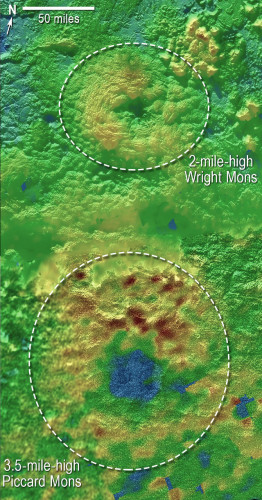
3-D topographic mapsWright Mons and Piccard Mons, the possible cryovolcanoes. The color depicts changes in elevation, blue indicating lower terrain and brown showing higher elevation. Green terrains are at intermediate heights (Image NASA/JHUAPL/SwRI)

NASA’s New Horizons mission team is presenting the latest findings on the dwarf planet Pluto at the 47th Annual Meeting of the American Astronomical Society’s Division for Planetary Sciences in National Harbor, Maryland. The data collected by the spacecraft during its July 14, 2015 flyby made it possible to identify possible cryovolcanoes. Data on small moons of Pluto are limited but suggest more and more that at least Cerberus and Hydra are the result of the merger of two or more asteroids.

Locations of 19 auroral detections (white circles) on Mars The data is superimposed on the magnetic field line structure where red indicates closed magnetic field lines, grading through yellow, green and blue to open field lines in purple (Image based on data from J-C. Gérard et al (2015))

Two articles, one published in “Journal of Geophysical Research: Space Physics” and one published in the journal “Icarus”, describe a research on ultraviolet auroras detected on Mars by ESA’s Mars Express space probe. Jean-Claude Gérard and Lauriane Soret of the University of Liege, Belgium, led a team of scientists who examined ten years of data that were analyzed to understand the mechanisms of creation of these auroras.

Artistic representazion of a solar storm stripping gas from Mars atmosphere (Image NASA/GSFC)

Two magazines host a number of articles describing the results of a year of the mission of NASA’s MAVEN space probe, “Science” and “Geophysical Research Letters”. The conclusions about why Mars lost most of its atmosphere were also explained in a NASA press conference held yesterday. Simply put, it was solar wind, which could take away the atmosphere thanks to the absence of a protective magnetic field transforming a planet that was originally similar to Earth in the desolate red planet we know today.

Diagram of coronal eruption. At the left the corona (feature in purplish colors) gathers inward, becoming brighter, before shooting away from the black hole (middle and right) (Image NASA/JPL-Caltech)

An article published in the journal “Monthly Notices of the Royal Astronomical Society” describes the detailed observation of a huge X-ray eruption by a supermassive black hole known as Markarian 335 or Mrk 335. The Swift and NuSTAR space telescopes were used to examine this phenomenon of gigantic proportions concluding that it originated from a coronal ejection.