
Astronomy / Astrophysics

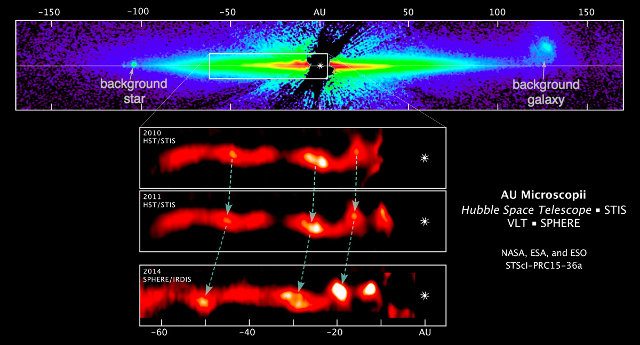
Images of the dust disk around the star AU Microscopii taken by the Hubble Space Telescope and SPHERE (Image NASA, ESA, ESO, A. Boccaletti (Paris Observatory))

An article just published in the journal “Nature” describes the discovery of mysterious ripples across the disk of dust surrounding the star AU Microscopii, or AU Mic. Through SPHERE, an instrument mounted on ESO’s Very Large Telescope, a team led by Anthony Boccaletti, LESIA (Observatoire de Paris/CNRS/UPMC/Paris-Diderot), France, discovered these structures never seen before and yet to be explained.

The Indian government has signed the agreement that allows the country into the SKA Organisation and will from now on be fully involved in the development of the SKA radio telescope. India joins Australia, Italy, Netherlands, New Zealand, South Africa and the United Kingdom in the task of the SKA into an intergovernmental organization with a treaty to formalize the relationship between the project and its members.

Picture of Charon take by NASA's New Horizons space probe (Image NASA/JHUAPL/SwRI)

If the images of the dwarf planet Pluto published by NASA in recent months haven’t been enough for you, now high-resolution photos of Charon, its largest moon, have been released. The first images arrived soon after the New Horizons space probe’s July 14, 2015 flyby had already shown a moon with a complex geology. These new images show even better the deep chasms that ply its equator and the curious color of its north pole.

Map-projected view of the dwarf planet Ceres (Image NASA/JPL-Caltech/UCLA/MPS/DLR/IDA)

The mysteries of the dwarf planet Ceres are a topic of discussion at the European Planetary Science Congress going on these days in Nantes, France. For the occasion, NASA published new topographic maps of Ceres based on data collected by its Dawn space probe, which has been mapping it for a few weeks. The latest news on this dwarf planet came from some emission of energetic electrons.

On the left, OSIRIS images used to visually identify over 100 terraces (green). In the middle, a 3D shape model used to determine the directions in which the terraces/strata are sloping and to visualise how they extend into the subsurface. On the right, local gravity vectors visualised on the comet shape model perpendicular to the terrace/strata planes (Image ESA/Rosetta/MPS for OSIRIS Team MPS/UPD/LAM/IAA/SSO/INTA/UPM/DASP/IDA; M. Massironi et al (2015))

At the European Planetary Science Congress going on these days in Nantes, France, evidence were presented that the strange shape of the nucleus of comet 67P/Churyumov-Gerasimenko is due to the fact that it was born from the merger of two small comets occurred a few billion years ago. The study conducted by a team led by Matteo Massironi, a researcher at the University of Padua and Italian INAF (National Institute of Astrophysics) associate, was published in the journal “Nature”.