Astronomy / Astrophysics

Image of narrow streaks of water on Martian slopes at Hale Crater (Image NASA/JPL-Caltech/Univ. of Arizona)

Yesterday NASA announced the existence of flows of liquid water on Mars. The study, just published in the journal “Nature Geoscience”, is based upon years of analysis of data collected mainly thanks to the NASA’s MRO (Mars Reconnaissance Orbiter) space probe. The images captured by its camera and spectrometric data allowed to find streams of water along the walls of craters and slopes that vary over time and perchlorate salts in them.

Astrosat blasting off atop a PSLV-XL rocket (Photo courtesy ISRO. All rights reserved)

A few hours ago the Astrosat space observatory was launched on a PSLV-XL rocket from the Satish Dhawan Space Centre in the flight listed as PSLV-C30 by ISRO, the Indian space agency. After about 22 minutes Astrosat regularly separated from the rocket’s upper stage to enter an orbit close to the equator at an altitude of about 650 kilometers (about 400 miles). Along with it six satellites were launched for customers of different nations: the Indonesian Lapan-A2 microsatellite, the Canadian NLS-14 (EV9) microsatellite and four USA LEMUR nanosatellites.

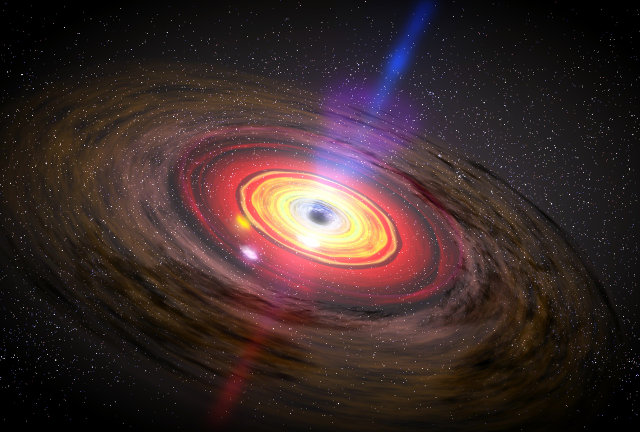
A still frame from a movie showing an active galactic nucleus (Image NASA / Dana Berry / SkyWorks Digital)

An article in the journal “Monthly Notices of the Royal Astronomical Society” describes a study of the galaxy SAGE0536AGN and in particular the supermassive black hole at its center, which is 30 times larger than expected. This is the result of measurements conducted by a team of astronomers at Keele University and the University of Central Lancashire, an anomaly all to explain.

The snakeskin area called Tartarus Dorsa on Pluto's surface (Image NASA/JHUAPL/SWRI)

After more than two months since the extraordinary Pluto flyby of NASA’s New Horizons space probe some people might think that the data arrived to Earth are enough to know this dwarf planet comprehensively. Reality keeps on being very different on this small world frozen yet as varied as you would expect from a geologically active planet with an atmosphere that can erode its soil. Here then is the image of a “snakeskin” surface that again leaves scientists puzzled and surprised.

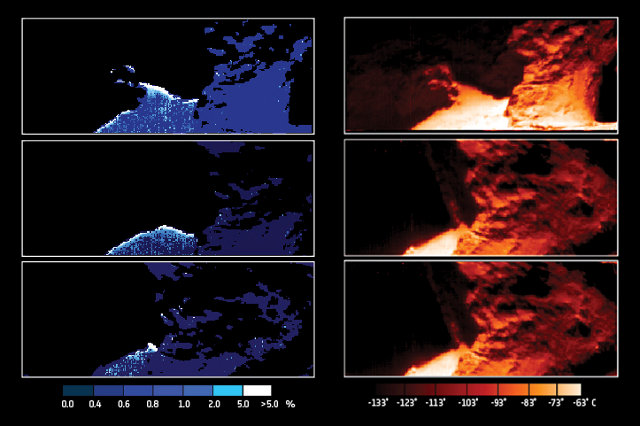
Maps of water ice abundance (left) and surface temperature (right) focusing on the Hapi ‘neck’ region of Comet 67P/Churyumov–Gerasimenko (Image ESA/Rosetta/VIRTIS/INAF-IAPS/OBS DE PARIS-LESIA/DLR; M.C. De Sanctis et al (2015))

An article just published in the journal “Nature” describes a research on the daily water-ice cycle on the surface of the comet 67P/Churyumov-Gerasimenko and its vicinity. A team of scientists led by Maria Cristina De Sanctis from Rome’s IAPS-INAF (National Institute of Astrophysics – Institute for Astrophysics and Space Planetology) analyzed data collected by the ESA’s Rosetta space probe’s VIRTIS spectrometer discovering that in some areas the ice water disappears in the day and reappears in the night.