Astronomy / Astrophysics

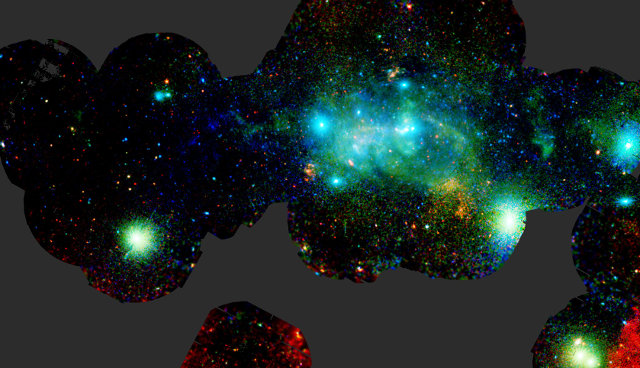
X-ray view of the Milky Way center (Image ESA/XMM-Newton/G. Ponti et al. 2015)

An article published in the journal “Monthly Notices of the Royal Astronomical Society” describes a research about the central region of the Milky Way. Using ESA’s XMM-Newton X-ray space observatory, a team of scientists from the Max Planck Institute for Extraterrestrial Physics (MPE) led by Dr. Gabriele Ponti revealed the most intense processes going on at the center of the galaxy.

Examples of the fractures detected on the surface of the comet 67P/Churyumov-Gerasimenko (Image ESA/Rosetta/MPS for OSIRIS Team MPS/UPD/LAM/IAA/SSO/INTA/UPM/DASP/IDA)

While the comet 67P/Churyumov-Gerasimenko started moving away from the Sun, new studies have been published based on data collected over the past months. An article published in the journal “Geophysical Research Letters” describes the exam of the many fractures photographed after the arrival of ESA’s space probe Rosetta. Another article published in the journal “Annales Geophysicae” provides an explanation for the “song” of the comet discovered last year.

Picture of the galaxy NGC 428 taken by the Hubble Space Telescope (Photo ESA/Hubble and NASA and S. Smartt (Queen's University Belfast))

A photograph of the galaxy NGC 428 taken by the Hubble Space Telescope shows its distorted and warped structure. Together with traces of a significant amount of stars being formed, it’s the sign of the merger between two galaxies. For this reason, its appearance could give us an idea of ​​what will happen in a few billion years to the Milky Way in its merger with Andromeda.

The 51 Eridani system photographed by the Gemini Planet Imager (Image Gemini Observatory and J. Rameau (UdeM) and C. Marois NRC Herzberg)

Planet 51 Eridani b is the first discovered using the Gemini Planet Imager (GPI), an instrument that started operating at the beginning of 2014 with the express purpose of directly detecting planets outside the solar system. This is the smallest exoplanet observed directly so far and its characteristics suggest that resembles Jupiter when it was very young. The results of this research were published in the journal “Science”.

Picture of the comet 67P/Churyumov-Gerasimenko near the perihelion (Photo ESA/Rosetta/NAVCAM)

During the day yesterday the comet 67P/Churyumov-Gerasimenko passed the perihelion, the point of closest approach to the Sun. ESA’s Rosetta space probe was at a distance of about 327 kilometers (about 203 miles) and with its NAVCAM instrument took a series of pictures to document the comet’s activities. Thanks to the heat it’s been receiving from the Sun the spectacular jets of gas generated by ice sublimation will continue for a few weeks.