Astronomy / Astrophysics

The fading light of supernova SN 2025kg, followed by the fast X-ray transient EP 250108a, as seen by the Gemini North and South telescopes

Two articles accepted for publication in “The Astrophysical Journal Letters” report different aspects of the study of supernova SN 2025kg, which generated a so-called fast X-ray transient, a little-known event that in this case was cataloged as EP 250108a. This type of event has now been described as a sort of stifled-at-birth version of a gamma-ray burst.

Two teams of researchers with several members in common used data collected by two instruments on the Einstein Probe space telescope and other instruments to analyze the emissions from this supernova. This allowed them to propose an explanation for the fast X-ray transients (FXTs) and how they differ from gamma-ray bursts.


Interstellar comet 3I/ATLAS

Several scientific organizations have announced the detection of what appears to be an interstellar comet, which has consequently received the designation 3I/ATLAS. It could be a large comet, with an estimated width of around 20 kilometers, but the first estimates of the size of its nucleus are still very rough. Its trajectory will take it within the orbit of Mars, but, together with its considerable speed, it will only lead to a limited direction change by the Sun’s gravity. Unfortunately, it will never get close enough to Earth to allow detailed observations, but any interstellar object is very interesting for astronomers. This is the third officially recognized “visitor” after 1I/ʻOumuamua in 2017 and 2I/Borisov in 2019.

Arcadia Planitia on Mars

ESA has published a photo of the Arcadia Planitia region on Mars captured by its Mars Express space probe’s High Resolution Stereo Camera (HRSC). This is an interesting region from a geological point of view because it’s northwest of the large volcanoes of Tharsis, the largest in the entire solar system, and traces of ancient lava flows are still visible. It could be important for the exploration of the red planet if confirmation of the presence of frozen water right under the surface were to arrive.

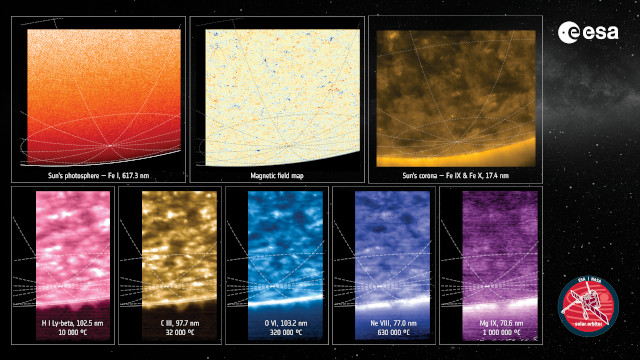
The Sun observed across eight different wavelengths by the Solar Orbiter space probe

ESA has released the first information, including the first images, of the Sun’s South Pole, captured between March 16 and 17, 2025, by the Solar Orbiter space probe, a mission operated in collaboration with NASA. Three of the scientific instruments on board made it possible to observe that area in different electromagnetic bands: Polarimetric and Helioseismic Imager (PHI), Extreme Ultraviolet Imager (EUI), and Spectral Imaging of the Coronal Environment (SPICE). The Sun’s poles aren’t visible from Earth, and Solar Orbiter is observing them as never before. The first observations have already revealed some surprises.

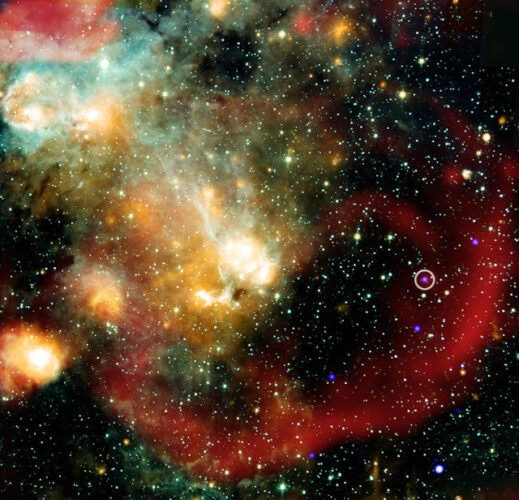
ASKAP J1832-0911 (in the circle) (Image X-ray: NASA/CXC/ICRAR, Curtin Univ., Z. Wang et al.; Infrared: NASA/JPL/CalTech/IPAC; Radio: SARAO/MeerKAT; Image processing: NASA/CXC/SAO/N. Wolk)

An article published in the journal “Nature” reports a study on ASKAP J1832-0911, or simply ASKAP J1832, an object whose nature is still uncertain. A team of researchers combined data collected by different instruments, including NASA’s Chandra X-ray Observatory and the ASKAP radio telescope, to detect the emissions coming from this object. This allowed them to reveal anomalies with respect to the categories considered to try to identify it.

The radio emissions led to cataloging it as a long-period radio transient, but ASKAP J1832 has variable emissions of the same duration in X-rays as well. An object with that type of emissions has never been found before, so it arouses a lot of curiosity. It could be a magnetar or a white dwarf with a companion star, but its behavior remains strange, so the investigations will continue.