Astronomy / Astrophysics

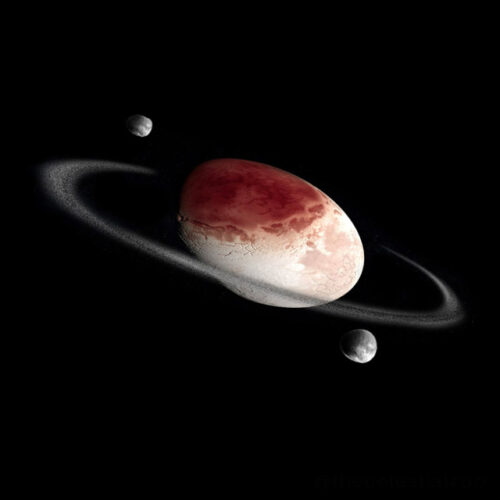
An artistic representation of Haumea with its moons Hiʻiaka and Namaka, which are actually much farther away from it, and its ring

An article published in the “Planetary Science Journal” reports the results of simulations that reproduce the possible history of the dwarf planet Haumea that led to its peculiar oval shape. A team of researchers used the geophysical and geochemical data available on Haumea and the asteroids that form a family with this dwarf planet to understand what processes led to their formation and evolution. The simulations lead to a reconstruction of the process that resulted in Haumea’s remarkable fast spin, which in turn led to its present shape.

The GRB221009A gamma-ray burst observed by Swift (Image NASA/Swift/A. Beardmore (University of Leicester)

A record-breaking gamma-ray burst was observed thanks to a series of space and ground-based telescopes on October 9, 2022. The fast global alert system existing among astronomical organizations made it possible to use several instruments to detect the event and its consequences over the next few days. Cataloged as GRB221009A, it’s already been called the gamma-ray burst of the century because it was very powerful even by the standards of these extremely energetic events. It may have been caused by a supernova that gave birth to a black hole but studies of the information collected have just begun.

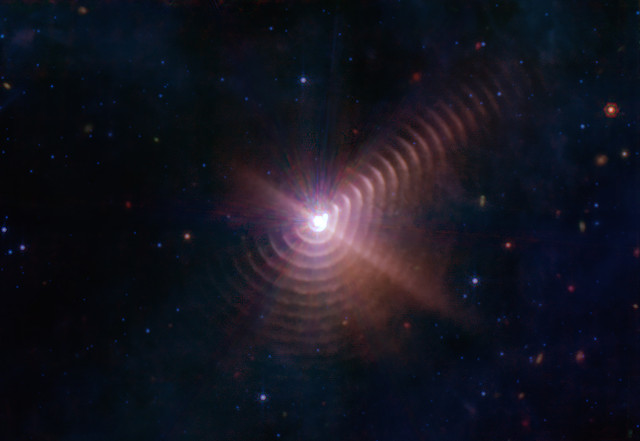
WR 140, its companion, and the rings around them (Image NASA, ESA, CSA, STScI, JPL-Caltech)

An article published in the journal “Nature Astronomy” reports the observation of 17 dust rings around WR 140, a so-called Wolf-Rayet star that has a very young and massive companion. A team of researchers used the James Webb Space Telescope’s MIRI instrument to study the area around this pair of stars, obtaining results far superior to those of other instruments, which had only identified two rings. According to the researchers, the rings are generated when the two stars get closer and their stellar winds interact violently causing the gas to compress, as it also contains elements heavier than hydrogen and allows it to form dust.

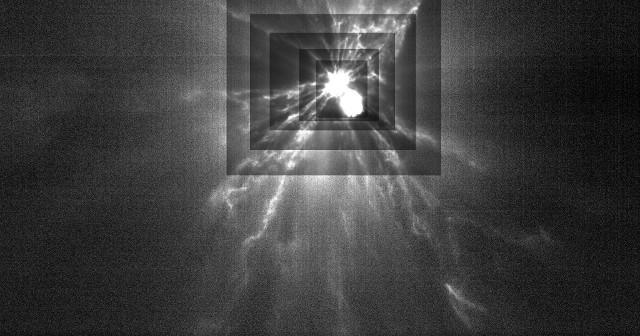
Asteroid Dimorphos and the ejected materials seen by LICIACube (Image ASI/NASA/APL)

In a press conference, NASA confirmed the success of its DART mission after ascertaining that the orbit of asteroid Dimorphos was changed by the impact of the spacecraft. According to calculations, Dimorphos now orbits the asteroid Didymos in 11 hours and 23 minutes while before the impact, it took 11 hours and 55 minutes for each orbit. The margin of error is approximately 2 minutes, which indicates that the success is far greater than the minimum predicted. The monitoring will continue, especially by the LICIACube mini-probe, to obtain more precise data, also on the materials ejected after the impact, as their characteristics will help to understand the composition of Dimorphos.

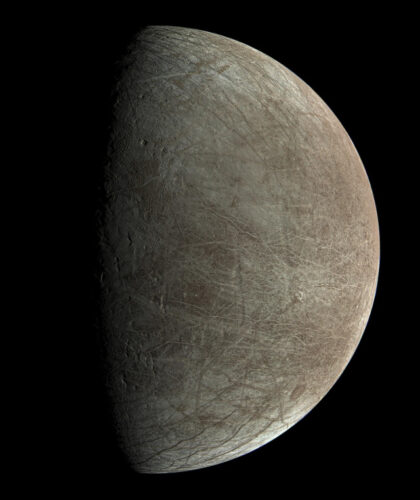
Europa seen by the Juno space probe (Image data: NASA/JPL-Caltech/SwRI/MSSSImage processing by Björn Jónsson)

NASA has released images of Europa, one of Jupiter’s so-called Galilean satellites, captured by its Juno space probe during a flyby conducted on September 29. The JunoCam was the main instrument for this task but for the occasion, a close-up shot was also captured by the SRU (Stellar Reference Unit), an instrument generally used to orient Juno by observing the stars. The photos taken by JunoCam were processed by some of the so-called citizen scientists, amateurs who contribute following their personal passion.