Astronomy / Astrophysics

The Cone Nebula seen by the FORS2 instrument of VLT (Image ESO)

ESO has released an image of the Cone Nebula captured using the FOcal Reducer and low dispersion Spectrograph 2 (FORS2) instrument mounted on the Very Large Telescope (VLT) as part of the 60th-anniversary celebrations of this astronomical research organization’s creation. The convention to create the European Southern Observatory was signed on October 5, 1962, and led to the construction of state-of-the-art telescopes, also in collaboration with other organizations. 60 years of astronomy are also celebrated with a campaign of observations that among other things captured the image of the Cone Nebula.

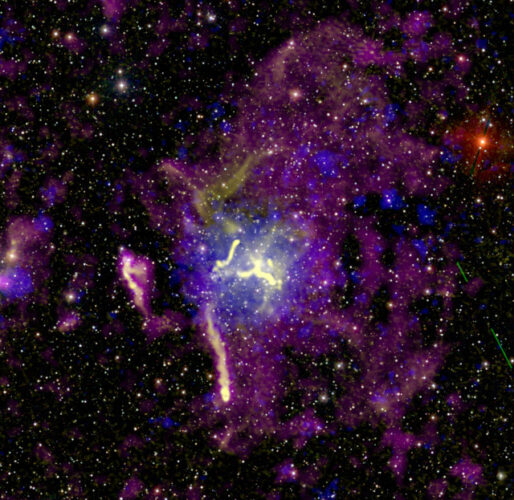
A composite view of the galaxy cluster Abell 2255

An article published in the journal “Science Advances” reports the results of a study of the galaxy cluster Abell 2255 which for the first time detected a radio glow on a scale so large that it surrounded the entire cluster. A team of researchers used the LoFar radio telescope for 18 nights over an area four times the size of the full moon to achieve such a detailed result. According to the researchers, the origin of that emission which is at least 16 million light-years wide is linked to the energy released during the cluster formation.

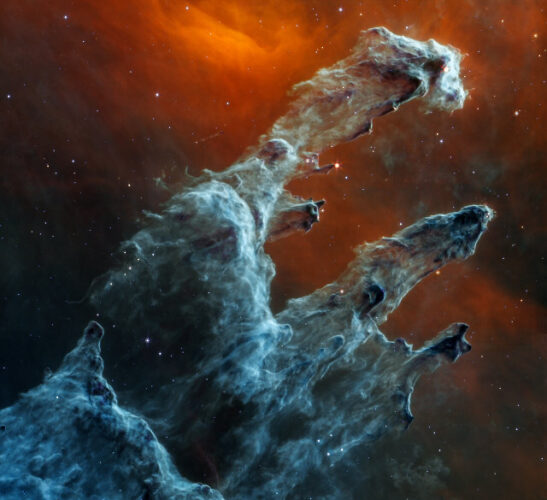
The Pillars of Creation as seen by the James Webb Space Telescope's MIRI instrument (Image NASA, ESA, CSA, STScI, J. DePasquale (STScI), A. Pagan (STScI))

A new image of the so-called Pillars of Creation was released, once again captured by the James Webb Space Telescope. It follows an image published a few days ago yet they show a landscape that looks very different with regards to the background of the structures that gave this star-forming area its nickname. This is due to the fact that this image was captured using the Mid-Infrared Instrument (MIRI), which sees in the mid-infrared, while the previous one was captured using the Near-Infrared Camera (NIRCam), which sees in the near-infrared. The different views offer a combination of information that is very useful in studying the gas and dust clouds in which there are young stars and others in the process of forming.

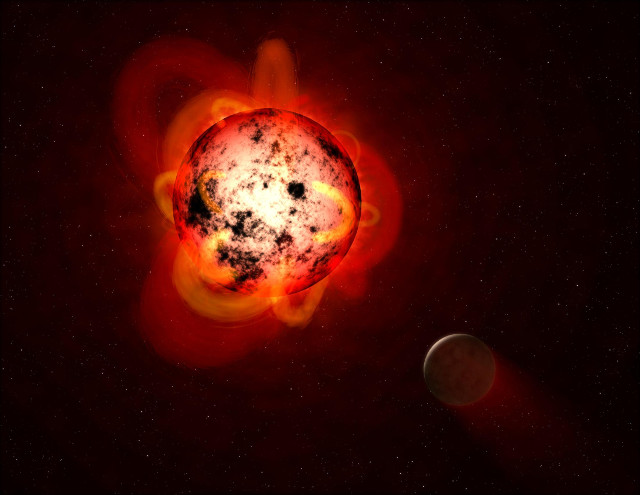
Artist's concept of a rocky planet's atmosphere being stripped by a red dwarf's flares

An article published in “The Astrophysical Journal Letters” reports a study on the exoplanet GJ 1252b which concludes that it has no atmosphere. In particular, a team of researchers used data collected by the Spitzer Space Telescope to examine this rocky planet which is about 20% larger than the Earth with a mass that is about 32% larger than the Earth’s. GJ 1252b orbits a red dwarf and according to the researchers, this star stripped this super-Earth’s atmosphere. This is due to the fact that red dwarfs are small but very active stars and confirms that it may be difficult to find a habitable planet around this type of star.

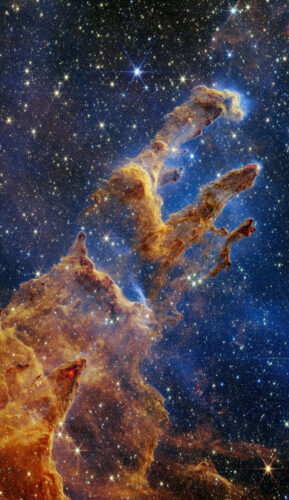
The Pillars of Creation seen by James Webb Space Telescope (Image NASA, ESA, CSA, STScI; J. DePasquale, A. Koekemoer, A. Pagan (STScI))

The so-called Pillars of Creation have been portrayed in some of the iconic images captured by the Hubble Space Telescope. Now the James Webb Space Telescope obtained even more detailed views of that star-forming area that is part of the Eagle Nebula. Webb’s infrared sensitivity can see even inside dust clouds where there are newborn stars and areas where stars are forming. That hasn’t only made it possible to obtain even more spectacular photos but also to provide a lot of new information useful to improve the models concerning star formation.