
Astronomy / Astrophysics

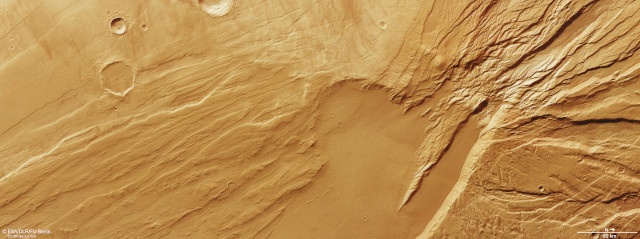
The area around the Acheron Fossae region on Mars

ESA has released images of the Acheron Fossae region on Mars captured by its Mars Express space probe’s High Resolution Stereo Camera (HRSC). The peculiarity of these images is that they show the two faces of Mars, meaning that they show how the red planet is basically divided into two parts with very different geological characteristics. About half of Mars is composed of an ancient terrain marked by craters and other signs of age and activity, while the other half is much smoother, with a surface probably reshaped by lava from volcanoes that are no longer active.

The galaxy JADES-GS-z13-1 (the red circle in the center) as seen by the James Webb Space Telescope (Image ESA/Webb, NASA, STScI, CSA, JADES Collaboration, Brant Robertson (UC Santa Cruz), Ben Johnson (CfA), Sandro Tacchella (Cambridge), Phill Cargile (CfA), J. Witstok, P. Jakobsen, A. Pagan (STScI), M. Zamani (ESA/Webb))

An article published in the journal “Nature” reports the results of observations of the primordial galaxy cataloged as JADES-GS-z13-1. A team of researchers used the James Webb Space Telescope to examine this galaxy, estimating that it dates back to about 330 million years after the Big Bang. The surprise came from spectroscopic analyses with so-called Lyman-alpha radiation, emitted in the ultraviolet by hydrogen in specific circumstances, because it was much stronger than would be expected from a galaxy of that era.

Herbig-Haro 49/50 (NIRCam and MIRI Image, annotated)

An image captured by the James Webb Space Telescope shows Herbig-Haro 49/50, or simply HH 49/50, a type of nebula associated with star formation. The Near-Infrared Camera (NIRCam) and Mid-Infrared Instrument (MIRI) instruments were used in combination to observe infrared details of the outflows whose shape led to the object being nicknamed the Cosmic Tornado. For years, astronomers have wondered what the object they could barely see in images obtained with other instruments at the “tip of the tornado” was, and Webb helped them realize that it’s a spiral galaxy that is far more distant.

Artist’s Illustration of Exoplanets Orbiting Barnard’s Star (Image International Gemini Observatory/NOIRLab/NSF/AURA/P. Marenfeld)

An article published in “The Astrophysical Journal Letters” reports confirmation of the existence of four exoplanets that are smaller than Earth orbiting Barnard’s Star. A team of researchers combined detections obtained with the MAROON-X instrument mounted on the Gemini North telescope in Hawaii with others obtained independently with the ESPRESSO instrument installed on ESO’s VLT in Chile. The result is the confirmation of the exoplanet Barnard b, whose existence was announced in October 2024, and three other sub-Earths, small planets that are almost certainly rocky.

The SPHEREx space telescope and the PUNCH satellites blasting off atop a Falcon 9 rocket (Image courtesy SpaceX)

A few hours ago, the SPHEREx space telescope and the PUNCH satellites, two NASA astronomy missions, blasted off atop a SpaceX Falcon 9 rocket from the Vandenberg base. After about 42 minutes, SPHEREx successfully separated from the rocket’s last stage, and about 10 minutes later, the PUNCH satellites also separated, within about a minute. Both missions will operate from a Sun-synchronous orbit at an altitude of 700 kilometers for SPHEREx and 570 kilometers for PUNCH.