Astronomy / Astrophysics

M51 and an illustration of the system that could host an exoplanet

An article published in the journal “Nature Astronomy” reports the identification of a candidate exoplanet in another galaxy, cataloged as M51-ULS-1b. A team of researchers used NASA’s Chandra X-ray Observatory and ESA’s XMM-Newton Space Telescope to examine what could be the transit of a Saturn-sized exoplanet in M51, a pair of galaxies. In the larger of the two galaxies, there’s an ultra-luminous X-ray source consisting of a dead star and a blue supergiant, and the candidate exoplanet orbits them. The first confirmation of an extragalactic exoplanet would be extraordinary but in this case, not all alternative explanations can be completely ruled out.

The exoplanet 2M0437b near its star

An article published in the journal “Monthly Notices of the Royal Astronomical Society” reports the discovery of a newborn planet orbiting the red dwarf star 2M0437. A team coordinated by the University of Hawaii at Mānoa used various telescopes to confirm that the discovered object was a planet orbiting that star and to capture a direct image of it. 2M0437b is one of the youngest exoplanets discovered so far, born together with its star in the Taurus Cloud, a stellar nursery that has been the subject of various astronomical studies.

The galaxies NGC 4567 (top) and NGC 4568 (bottom) with supernova SN 2020fqv in the inset

An article to be published in the journal “Monthly Notices of the Royal Astronomical Society” reports observations of a supernova that was cataloged as SN 2020fqv in the galaxy NGC 4568. A team of researchers used the Hubble Space Telescope combining data collected with other instruments to study this supernova starting from the first moments of the explosion. Information on the last moments of the progenitor star’s life, on the materials very close to the supernova ejected from the star in the last year of its life, and on the first phase of the supernova will help find the signs of other upcoming supernovae.

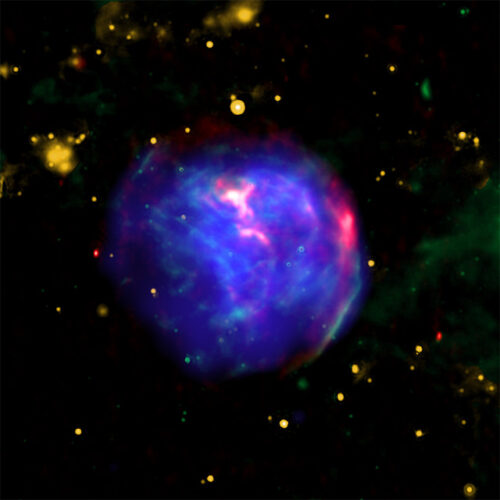
Composite image of G344.7-0.1 (X-ray: NASA/CXC/Tokyo Univ. of Science/K. Fukushima, et al.; IR: NASA/JPL/Spitzer; Radio: CSIRO/ATNF/ATCA)

An article published in “The Astrophysical Journal” reports a study on the supernova remnants cataloged as G344.7-0.1. A team of researchers combined observations in different bands of the electromagnetic spectrum to study the consequences of a Type Ia supernova, the explosion of a white dwarf that reached critical mass after stealing gas from a companion. These remnants can show in particular the effects of what is called reverse shock and offer new information to better understand these supernovae, important in the creation of elements such as iron that are scattered in interstellar space.

Infographic of water vapor's presence in Europa's atmosphere (Image ESA/Hubble, J. da Silva)

An article published in the journal “Geophysical Research Letters” reports the detection of a stable presence of water vapor in the atmosphere of Jupiter’s moon Europa. Lorenz Roth of the Kth Royal Institute of Technology in Stockholm, Sweden, used ultraviolet observations conducted with the Hubble Space Telescope between 1999 and 2015 to infer the presence of water vapor. Its presence appears to be persistent only in one hemisphere of Europa, the one opposite the moon’s direction of motion in its orbit.