Astronomy / Astrophysics

The Lucy space probe blasting off atop an Atlas V 401 rocket (Image NASA TV)

A little while ago NASA’s Lucy mission blasted off atop an Atlas V 401 rocket from Cape Canaveral. Almost 58 minutes after launch, the space probe separated regularly from the rocket’s last stage and entered the trajectory that is programmed to lead it towards Jupiter’s orbit, where there are the so-called Jupiter’s Trojan asteroids. There, Lucy will begin a series of flybys on a mission that is expected to last approximately 12 years.

Artist's concept of red dwarf magnetically interacting with a planet (Image courtesy Danielle Futselaar (artsource.nl))

Two articles – one published in the journal “Nature Astronomy” and one published in “The Astrophysical Journal Letters” – report different aspects of the discovery of radio wave emissions from 19 red dwarfs of which at least 4 could have originated from interaction with unknown planets. This study is based on detections obtained with the LOFAR radio telescope to examine the stellar magnetic activity of 19 red dwarfs. Radio emissions have also been detected from ancient and magnetically inactive stars. Data collected by NASA’s TESS space telescope was also added to get a more complete picture of that activity. The most likely explanation is that there’s an interaction with the magnetic field of planets that haven’t been detected.

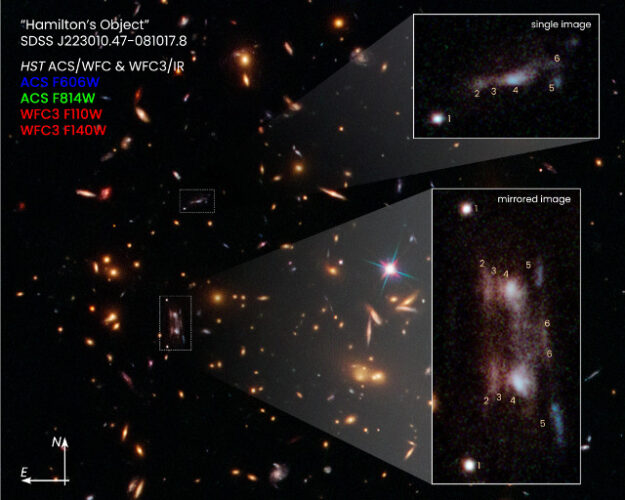
Hamilton's Object seen by Hubble

An article published in the journal “The Monthly Notices of the Royal Astronomical Society” reports a solution to an astronomical mystery involving two galaxies that appeared to be mirror images of each other and turned out to be two images of the same galaxy doubled by a gravitational lens. A team of researchers led by Richard Griffiths of the University of Hawaii at Hilo used observations made with the Hubble Space Telescope to obtain enough information to understand the nature of what was named Hamilton’s Object because it was discovered by astronomer Timothy Hamilton. Meanwhile, a third image of the galaxy was discovered, visible in another area of ​​the sky again thanks to the gravitational lens.

An article published in “The Astrophysical Journal Letters” reports a study on the exoplanet WASP-76b, an ultra-hot Jupiter where conditions could be even more hellish than previously thought. A team of researchers used the Gemini North telescope to study WASP-76b, the case that inaugurates a planetary atmosphere mapping project at Cornell University as part of ExoGemS (Exoplanets with Gemini Spectroscopy Survey). The discovery of abundant ionized calcium indicates that the temperature in the atmosphere is much higher than previous estimates or that there are very intense winds in the upper atmosphere.

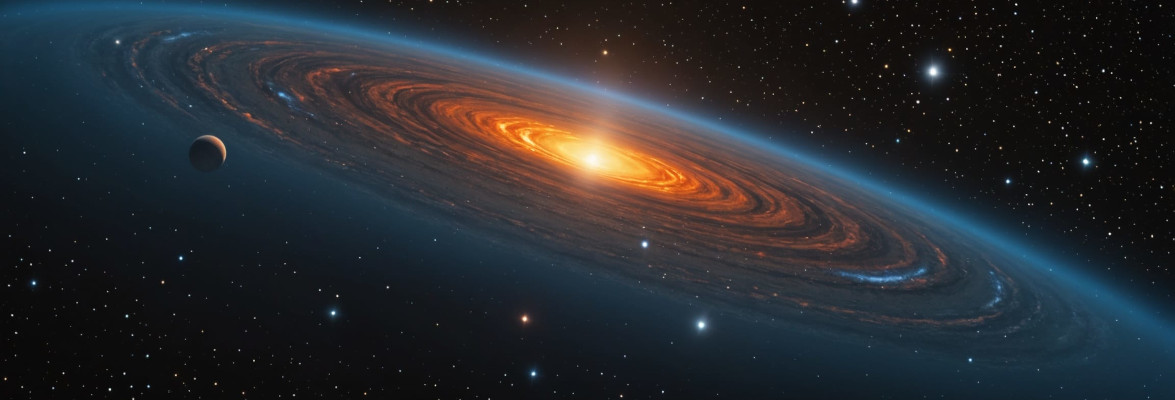
GW Orionis' protoplanetary dsk

An article published in the journal “Monthly Notices of the Royal Astronomical Society” reports a study on the triple system of GW Orionis, or simply GW Ori, which claims that there is at least one exoplanet, which would be the first known to orbit three stars. A team of researchers led by Jeremy Smallwood of the University of Nevada Las Vegas examined observations of the rings of GW Ori’s protoplanetary disk made with the ALMA radio telescope. The goal was to try to establish the cause of the presence of void within one of them and the conclusion is that one or more exoplanets have formed or are forming.