Astronomy / Astrophysics

The distribution of the 36 dwarf galaxies around the Milky Way

An article published in “The Astrophysical Journal” reports the discovery of 36 dwarf galaxies that are simultaneously showing signs of the start of remarkable star-forming activity. A team of researchers examined a group of dwarf galaxies observed during the ANGST survey noting a simultaneous acceleration in star-forming activity despite the fact that they’re separated even by several million light-years. This is a phenomenon that has no explanation in current models of galaxy evolution.

The likely galaxies where the origins of fast radio bursts cataloged as FRB 190714 (top) and FRB 180924 (bottom) was located

An article to be published in “The Astrophysical Journal” reports the location of the origin of eight fast radio bursts (FRBs) detected between 2017 and 2020. A team of researchers coordinated by the University of California at Santa Cruz used the Hubble Space Telescope to accomplish this task by applying a method already used to pinpoint the origin of other cosmic phenomena such as supernovae and gamma-ray bursts. This result offers new information on an extremely energetic phenomenon such as fast radio bursts, which emit an amount of energy in a millisecond comparable to the amount the Sun emits in a year. The results of this study are compatible with the theory that links them to magnetars.

Comet C/2016 R2 (PANSTARRS) and its spectrum (Image ESO/L. Calçada, SPECULOOS Team/E. Jehin, Manfroid et al.)

Two articles published in the journal “Nature” report different studies on the materials present in the atmospheres of comets, which appear to contain iron and nickel even in the ones far from the Sun. Jean Manfroid, Damien Hutsemekers, and Emmanuel Jehin used data collected by the UVES spectrograph of ESO’s VLT in Chile to analyze the atmospheres of various comets detecting the presence of both iron and nickel. Piotr Guzik and Michał Drahus used the X-shooter spectrograph, also of the VLT, to examine in particular the interstellar comet 2I/Borisov detecting the presence of nickel. They were surprising results because the sublimation of heavy metals was thought possible only near the Sun.

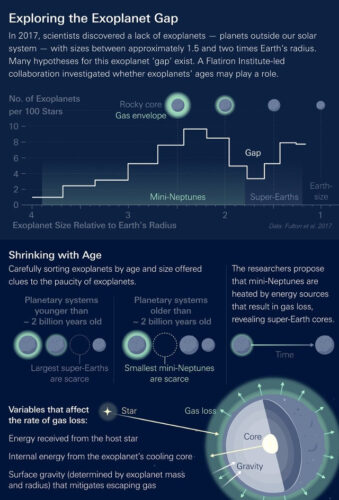
An infographic that illustrates the statistics of exoplanets with the radius gap and the possible mechanisms that make mini-Neptunes shrink until they turn into super-Earths

An article published in “The Astronomical Journal” reports a study on the scarcity of exoplanets with a radius between 1.5 and 2 times the Earth’s. A team of researchers led by Trevor David of the Flatiron Institute in New York studied what is commonly referred to as a radius gap using data collected by NASA’s Kepler Space Telescope. By dividing the exoplanets studied between those older than 2 billion years and those younger, the exam offers new information confirming the theory that sub-Neptunes can lose most of their atmosphere and transform into super-Earths even after billions of years.

Schematical representation of the expansion of the Universe over the course of its history (Image courtesy NAOJ)

An article published in “The Astrophysical Journal” reports a calculation of the expansion velocity of the universe based on type Ia supernovae. A team of researchers led by Professor Maria Giovanna Dainotti used a sample of 1048 supernovae that have very different distances from Earth, dividing them into groups based on their distance. The values ​​obtained are decreasing starting from the nearest supernovae, and those obtained using the most distant supernovae approach the value based on the cosmic microwave background radiation.