Space Probes

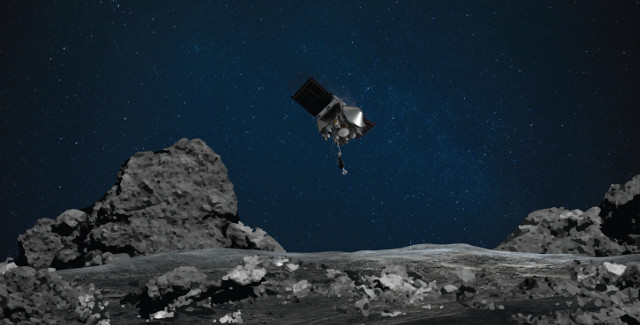
Artist's concept of OSIRIS-REx descending to Bennu's surface (Image NASA/Goddard/University of Arizona)

A few hours ago NASA’s OSIRIS-REx space probe descended to the surface of the asteroid Bennu to take soil samples in what was called TAG (Touch-And-Go). The selected area is in a crater that was named Nightingale with a diameter of about 16 meters in Bennu’s northern hemisphere. The operation was carried out fully automatically because there’s an 18.5 minute delay in communications due to the fact that OSIRIS-REx is about 334 million kilometers from Earth. If the result is satisfactory, this part of the mission will be over.

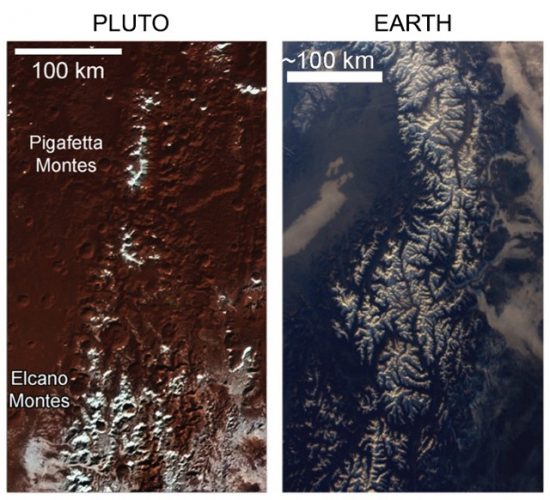
Pigafetta Montes and Elcano Montes on Pluto and the Alps

An article published in the journal “Nature Communications” reports a study that offers an explanation for the origin of the snowpack existing on the highest mountains of the dwarf planet Pluto that create a sort of alpine panorama since it resembles in many ways the Earth’s Alps. A team of researchers used data collected by NASA’s New Horizons space probe to figure out that the snow is mainly composed of methane. This compound can become solid under the conditions present on Pluto and forms that mantle through a process that’s very different from that one that leads to alpine snowfall.

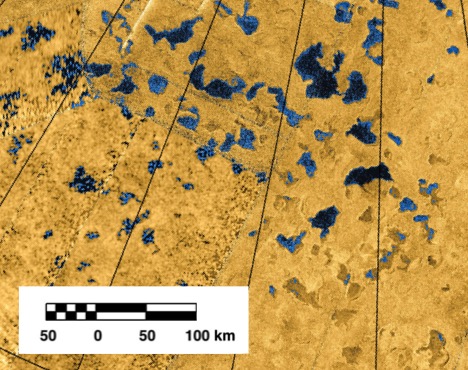
Titan's Lakes

An article published in the journal “The American Astronomical Society” reports a study on the hydrocarbon lakes existing on Titan, the great moon of Saturn, showing its similarities with the Earth’s lakes. A team of researchers led by Jordan Steckloff analyzed data collected by the Cassini space probe and discovered that the lakes of Titan composed of methane, ethane, and nitrogen form layers similar to the ones on Earth. The stratification mechanisms are different because on Earth layers are the consequence of temperature while on Titan they exist because of the particular chemical interactions between the surface liquids and the atmosphere.

Radar map of the Mars area where the lake system was found (Image courtesy Sebastian Emanuel Lauro et al. Nature Astronomy, 2020)

An article published in the journal “Nature Astronomy” reports the discovery of new underground lakes of very salty liquid water under the planet Mars’ south pole cap. A team of researchers led by Elena Pettinelli and Sebastian Lauro, both of the Italian Roma Tre University, used data collected by ESA’s Mars Express space probe’s Mars Advanced Radar for Subsurface and Ionosphere Sounding (MARSIS) instrument to discover what form a lake system consisting of three main lakes surrounded by other smaller lakes. This confirms the discovery of a lake announced in July 2018 and offers evidence that this is not a unique case. It remains an extreme environment, so it takes some speculation to imagine life forms in those lakes, but the authors of this new research also recommend increasing the exploration of those areas to understand their potential is to host life.

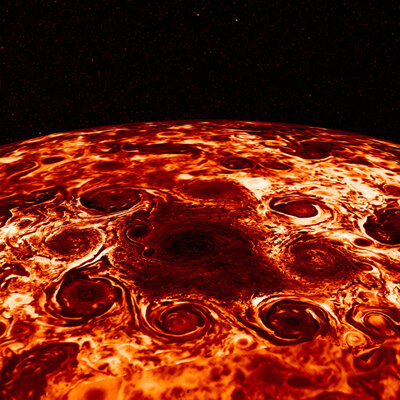
Jupiter's South Pole (Image NASA-JPL/Caltech)

An article published in the journal “Proceedings of the National Academy of Sciences” reports a study on storms at the planet Jupiter’s south pole and their regular geometric pattern. A team of researchers from the University of Berkeley and Caltech used mathematical models derived from 19th-century research by Lord Kelvin based on experiments by physicist Alfred Mayer to explain why those storms concentrated in that area and why on Jupiter they’re arranged in that geometric formation.