Space Probes

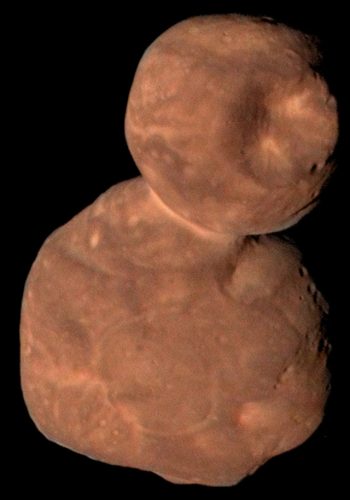
Arrokoth (Image NASA/Johns Hopkins University Applied Physics Laboratory/Southwest Research Institute/Roman Tkachenko)

Three articles published in the journal “Science” report various aspects of a research on the origins and characteristics of Arrokoth, the Kuiper Belt object classified as 2014 MU69 and for some time known by the nickname Ultima Thule. Different teams of researchers with various members in common used data collected by NASA’s New Horizons space probe to study it from various points of view. One of the conclusions concerns its origin, which might have occurred following the collapse of a cloud of solid particles in the primordial solar nebula and not following the process known as hierarchical accretion, a process that has high-speed collisions between planetesimals.

The Solar Orbiter space probe blasting off atop an Atlas V rocket (Photo ESA - S. Corvaja)

A few hours ago the Solar Orbiter space probe blasted off atop an Atlas V rocket from Cape Canaveral. After about 53 minutes, it successfully separated from the rocket’s last stage and began the long journey that will take it up to about 42 million kilometers from the Sun. A little later it deployed its solar panels and started communicating with the mission control center.

Pluto

An article published in the “Journal of Geophysical Research” reports a study on the dwarf planet Pluto and in particular on the heart-shaped region called Tombaugh Regio and its influence on global atmospheric circulation. A team of researchers coordinated by NASA’s Ames Research Center used data collected by the New Horizons space probe to specifically study nitrogen circulation and its cycle appropriately compared to a heart beat. This is another confirmation that Pluto is an active small world despite its small size and thin atmosphere.

Salts of ammonium chloride (Photo courtesy University of Bern)

Two articles published in the journal “Nature Astronomy” report the results of as many analyzes of data collected by ESA’s Rosetta space probe which reveal the presence of compounds such as ammonium salts on the comet 67P/Churyumov-Gerasimenko. A team of researchers led by Kathrin Altwegg of the University of Bern, Switzerland, analyzed the data trying to understand the reasons for the scarcity of nitrogen on the comet, concluding that its presence is actually difficult to detect because a part is tied to ammonium salts. These salts are among the building blocks of molecules that include some precursors of life such as urea and glycine, already found on the comet. Another team discovered in the data traces of aliphatic compounds, considered essential for life on Earth, on the comet.

New confirmations that phosphorus was brought to Earth by comets

An article to be published in the journal “Monthly Notices of the Royal Astronomical Society” reports a study tracing the journey of phosphorus from star formation to comets. A team of researchers led by VĂ­ctor Rivilla of the Italian National Institute of Astrophysics used the ALMA radio telescope and data collected by ESA’s Rosetta space probe’s ROSINA instrument on comet 67P/Churyumov–Gerasimenko to understand where phosphorus is formed and how comets may have brought it to Earth, where it’s needed by life forms.