Space Probes

Artist's concept of a Voyager space probe (Image NASA/JPL-Caltech)

Five articles published in the journal “Nature Astronomy” report various detections carried out by NASA’s Voyager 2 space probe in interstellar space. A number of teams of researchers examined the data collected by the five instruments still in use with each article dedicated to the data from a single instrument. Taken together, they help to understand interstellar space outside the heliosphere, the bubble in which the influence of the Sun is felt. One year after coming out of that bubble, Voyager 2 sent a lot of data on plasma and cosmic rays showing the differences compared to those within the heliosphere.

Titan's dunes (Image courtesy University of Hawaii at Manoa)

An article published in the journal “Science Advances” reports a study that offers some answers to the mystery of the origin and composition of the dunes on Titan, one of the moons of the planet Saturn particularly interesting for many reasons that include the formation of many organic compounds. A team of researchers led by physical chemist Ralf I. Kaiser of the University of Hawaii at Manoa examined data collected during the Cassini-Huygens mission and computer simulations whose results indicate that acetylene exposed to cosmic rays can form materials that make up Titan’s dunes.

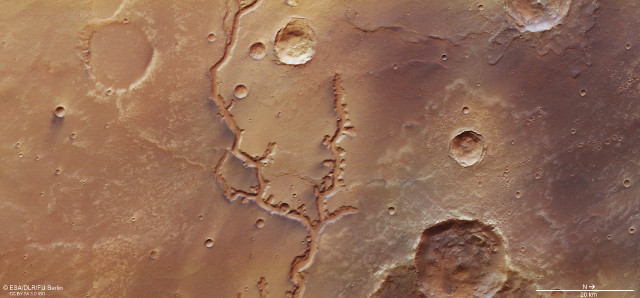
Nirgal Vallis on Mars (Image ESA/DLR/FU Berlin, CC BY-SA 3.0 IGO)

ESA has released new images captured by its Mars Express space probe’s High Resolution Stereo Camera (HRSC) showing Nirgal Vallis on the planet Mars. It’s a river valley that extends for over 700 kilometers, so vast that it crosses the Coprates and Margaritifer Sinus quadrangles. A few billion years ago, when the rivers were filled with liquid water, they probably filled Holden Crater, making it a lake with a diameter of about 150 kilometers and a depth of up to about 250 meters.

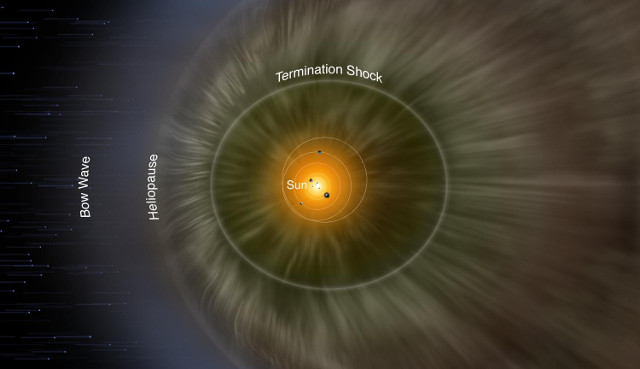
Illustration of the heliosphere (Image NASA/IBEX/Adler Planetarium)

A team of scientists led by Jamie Rankin of Princeton used measurements of the galactic cosmic rays detected by NASA’s Voyager space probes to obtain an estimate of the total pressure that plasma, magnetic fields and various particles exert on each other in the heliosheath, the outer region of the heliosphere, the big bubble around the Sun where solar wind exerts its influence. The result is higher than expected and will help to better understand the interactions between the Sun and its surroundings.

New organic compounds discovered on Saturn's moon Enceladus

An article published in the journal “Monthly Notices of the Royal Astronomical Society” reports the identification of organic compounds on Enceladus, the moon of Saturn which became famous in the last decade after the discovery of an underground ocean. A team of researchers led by Nozair Khawaja used data collected by the Cassini space probe’s Cosmic Dust Analyzer (CDA) to identify compounds that could be (di)methylamine, ethylamine and carbonyls in ice grains from the surface of Enceladus. They aren’t the first organic compounds that are formed on Enceladus and represent another interesting discovery in the search for life forms on that moon.