Space Probes

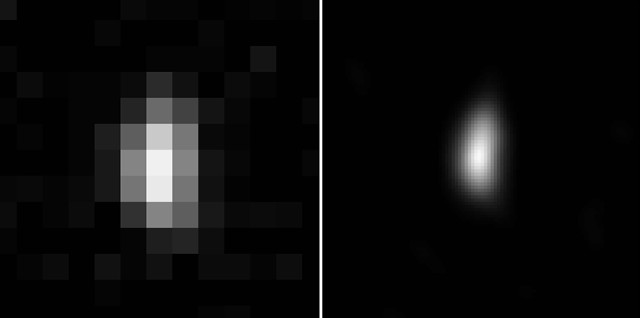
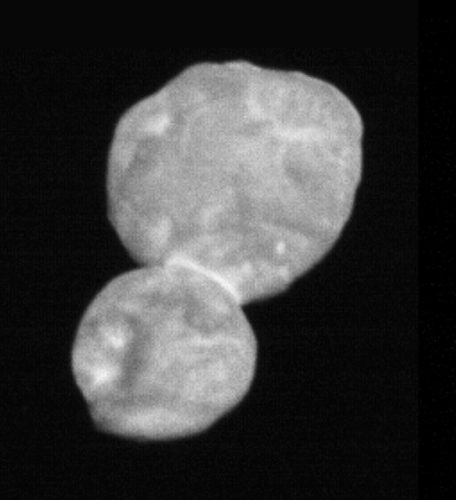
Ultima Thule is made up of two smaller asteroids

NASA published the first detailed images of the Kuiper Belt object cataloged as 2014 MU69 and nicknamed Ultima Thule. Captured by the New Horizons space probe’s LORRI and MVIC instruments approximately 90 to 30 minutes before its closest approach, they finally clearly show this object’s double-lobe structure. In jargon, it’s called a contact binary and is the result of two close objects that collide at low speed and end up merging. The larger lobe has been nicknamed Ultima and the smaller Thule.

The New Horizons space probe performed its Ultima Thule flyby

NASA’s New Horizons spacecraft has just completed its flyby of the object known as 2014 MU69 and nicknamed Ultima Thule. The automatic program to proceed with the photos and the other detections of its target was activated a few days ago so, after sending the last images taken when it was still almost two million kilometers away, New Horizons aimed its instruments at Ultima Thule. If all went well, in the next few hours it will communicate it to the mission control center and start sending the data it collected, a process that will continue for an estimated time in about 20 months.

Korolev crater (Image ESA/DLR/FU Berlin, CC BY-SA 3.0 IGO)

ESA has published new images of Korolev crater on Mars obtained thanks to of its Mars Express space probe’s High Resolution Stereo Camera (HRSC) instrument. Its peculiarity is that it’s filled with water ice and despite the presence of dust its color is white, which is a strong contrast with that of the surrounding land. Normally water can’t remain solid at the very low pressure generated by the Martian atmosphere but near the north pole Korolev crater acts like a cold trap.

Asteroid Bennu (Image NASA/Goddard/University of Arizona)

NASA has announced that its OSIRIS-REx space probe has found traces of water in the asteroid Bennu, reached on December 3. This is water bound to minerals present on Bennu’s surface, hydrated silicates formed in the very early stages of the solar system’s history, when the first small bodies such as the asteroids started forming.