Space Probes

Some Martian mounds (Image ESA/ TGO/ CaSSIS)

An article published in the journal “Nature Geoscience” reports a study on the mounds in Mawrth Vallis, a valley on the planet Mars considered very interesting for the traces of the ancient presence of liquid water. A team of researchers from the Open University and the Natural History Museum in London used data collected by various space probes to perform geomorphological and spectroscopic analyses of the mounds. Their conclusions are that they’re the remains that were formed by erosion by the retreat of the plateau in the Noachian period, between 4.1 and 3.7 billion years ago. For this reason, they believe that they constitute a sort of stratigraphic record of the changes in the presence of water in Mawrth Vallis.

The Australe Scopuli region on Mars (Image ESA/DLR/FU Berlin (CC-BY-SA 3.0 IGO))

ESA has published reprocessed images of the Australe Scopuli region of Mars captured by its Mars Express space probe’s High Resolution Stereo Camera (HRSC). The area is covered in what appears to be snow but is actually carbon dioxide ice and dust. Despite the differences, the view is reminiscent of a Christmas landscape, especially the kind common at altitudes where it normally snows on Earth. It’s still a significant day because, on December 25, 2003, Mars Express entered Mars’ orbit.

NASA's Europa Clipper space probe blasting off atop a SpaceX Falcon Heavy rocket (Photo NASA)

A few hours ago, NASA’s Europa Clipper space probe blasted off atop a SpaceX Falcon Heavy rocket from the Kennedy Space Center. After just over an hour, it successfully separated from the rocket’s last stage and set off on its route that will take it into deep space, to Europa, Jupiter’s moon with an icy surface that hides an ocean of liquid water to understand if it’s habitable.

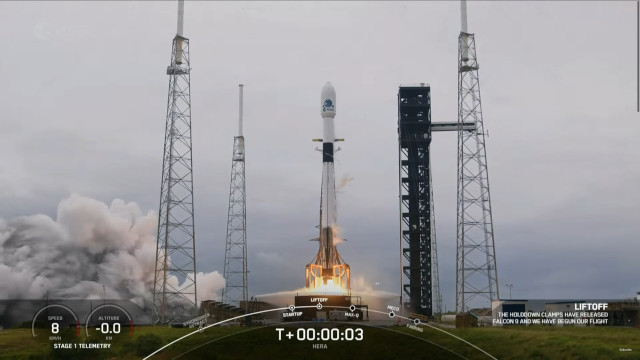
The Hera space probe blasting off atop a Falcon 9 rocket (Image courtesy SpaceX)

Yesterday, ESA’s Hera space probe blasted off atop a SpaceX Falcon 9 rocket from the Cape Canaveral together with the two nanosatellites Juventas and Milani. After about 76 minutes, it successfully separated from the rocket’s last stage and set on its course which in almost exactly two years will take it to the asteroid Didymos and its moon Dimorphos to examine the consequences of the impact of NASA’s DART spacecraft.

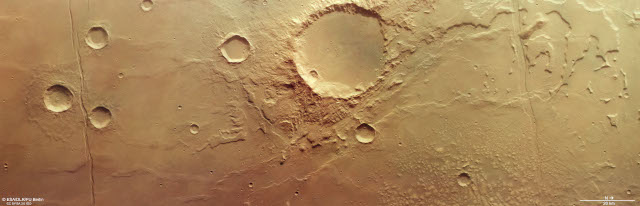
The Caralis Chaos on Mars

An image captured by ESA’s Mars Express space probe’s High Resolution Stereo Camera (HRSC) shows the region of the planet Mars called Caralis Chaos. At first glance, it may seem like just another Martian area dotted with craters and wind-carved mounds, but when the red planet was young, it was home to Lake Eridania, larger than all the lakes on Earth. It covered an area of ​​more than a million square kilometers, including Atlantis Chaos, an area close to Caralis Chaos. That lake gradually dried up as the environmental collapse transformed an Earth-like planet into the one we see today.