Space Probes

Graphics showing heliosphere with the Voyager probes' positions (Image NASA/JPL-Caltech)

NASA announced that its Voyager 2 space probe could be close to interstellar space. Approximately 17.7 billion kilometers (almost 11 billion miles) from the Sun, it detected an increase in cosmic rays coming from outside the solar system, one of the criteria already used in the past to assess whether its twin Voyager 1 had reached interstellar space, an event confirmed in September 2013. The route of the two probes is different and is the reason why one of the two probes is farther than the other and the heliosphere doesn’t have a fixed size so NASA’s monitoring is continuing but there are no certainties yet.

Titan seen by Cassini (Image NASA/JPL-Caltech/University of Arizona/University Paris Diderot/IPGP)

An article published in the journal “Nature Geoscience” reports the evidence of the presence of dust storms in the equatorial regions of Titan, the largest of Saturn’s moons. A team of researchers analyzed data collected by the Cassini space probe to find those evidence that make Titan the third object in the solar system where dust storms were discovered after the Earth and Mars. This is a further similarity between Titan and the Earth.

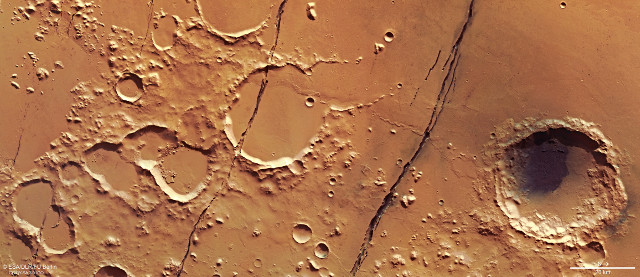
The Cerberus Fossae (Image ESA/DLR/FU Berlin, CC BY-SA 3.0 IGO)

ESA has published photos taken by its Mars Express space probe of the Cerberus Fossae, fractures that run almost parallel for more than 1,000 kilometers in the area near the equator of the planet Mars. They’re part of a large volcanic complex called Elysium Planitia, where traces suggest that lava flows date back a few million years ago, recent in geological terms compared to the bulk of volcanic activity. The Cerberus Fossae were also formed relatively recently, less than 10 million years ago, probably originated from faults that stretched the upper layers of the surface apart.

Landslides and avalanches could be important to keep a comet active for a long time

An article published in the journal “Icarus” describes a research focused on the link between landslides and avalanches with the long-term activity of the comet 67P/Churyumov-Gerasimenko. Jordan K. Steckloff and Nalin H. Samarasinha of the Planetary Science Institute examined data collected by ESA’s Rosetta space probe in the course of its mission to conclude that those phenomena occurring on the surface of the comet, with the resulting waste of mass, are a key to keeping it active in the long term.

Saturn (Image ESA/Hubble, NASA, A. Simon (GSFC) and the OPAL Team, J. DePasquale (STScI), L. Lamy (Observatoire de Paris))

An article accepted for publication in the journal “Geophysical Research Letters” describes a series of observations at ultraviolet carried out with the Hubble space telescope of the planet Saturn’s northern aurora. A team of researchers conducted a campaign of observations over seven months before and after the northern summer solstice to get the maximum possible visibility for the aurora. The coordination with the Cassini mission’s Grand Finale offered new information about Saturn’s magnetosphere.