Space Probes

Occator Crater seen from above and in a perspective view that shows the highest amount of carbonates in red (Image NASA/JPL-Caltech/UCLA/MPS/DLR/IDA/ASI/INAF)

An article published in the journal “Nature” describes a new research on the famous white spots in the dwarf planet Ceres’ Occator Crater. According to a team led by Maria Cristina De Sanctis, INAF – IAPS, the most abundant mineral is sodium carbonate. It’s a surprising result because that’s a salt that on Earth is abundant in hydrothermal sources and this raises the possibility of the presence of liquid water in Ceres underground.

Faults on Pluto's surface (Image NASA/JHUAPL/SwRI)

An article about to be published in the journal “Geophysical Research Letters” boosts the theory of the existence of an underground ocean of liquid water on Pluto. An analysis of data collected by NASA’s New Horizons space probe during its July 14, 2015 flyby carried out by Noah Hammond, graduate student at Brown University, Providence, Rhode Island, USA, offers some clues to support this amazing possibility.

Electrons (in red) attract positive ions (in blue) pushing them out of the atmosphere (Image ESA–C. Carreau)

An article published in the journal “Geophysical Research Letters” describes the discovery of an electric wind on Venus that accelerates the ionized hydrogen and oxygen atoms that make up water molecules at such a speed that they disperse in space. A team of scientists led by Glyn Collinson, a scientist of NASA’s Goddard Space Flight Center, analyzed data from the ASPERA-4 instrument of ESA’s Venus Express space probe to find out this wind generated by Venus’ electric field.

Charon, Nyx and Hydra (Image NASA/JHUAPL/SwRI)

NASA has published a comparative analysis of the spectral measurements of three moons of the dwarf planet Pluto which prove that in particular Nyx but also Hydra have a surface covered in water ice. The New Horizons space probe’s LEISA instrument carried out the measurements during the July 14, 2015 flyby. Unfortunately the location of the other two small moons, Styx and Kerberos in those hours didn’t allow spectral measurements.

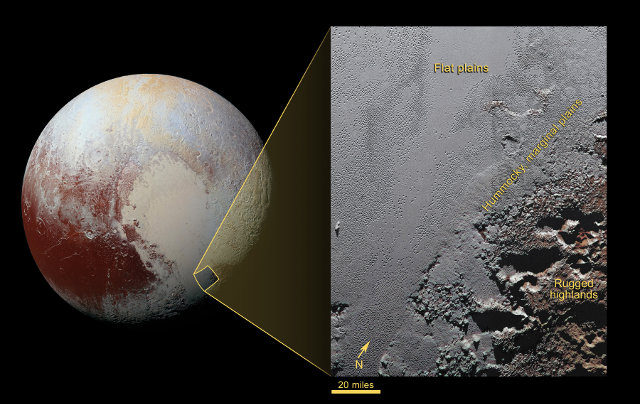
Krun Macula, the borders of Sputnik Planum and their place on Pluto (Image NASA/JHUAPL/SwRI)

NASA released an image of an area of ​​Pluto informally called Krun Macula that shows the variability on the dwarf planet. Obtained by putting together various photographs taken by NASA’s New Horizons space probe during its July 14, 2015 flyby, it shows the border area between the icy plains of the heart-shaped region and the nearby highlands.