Space Probes

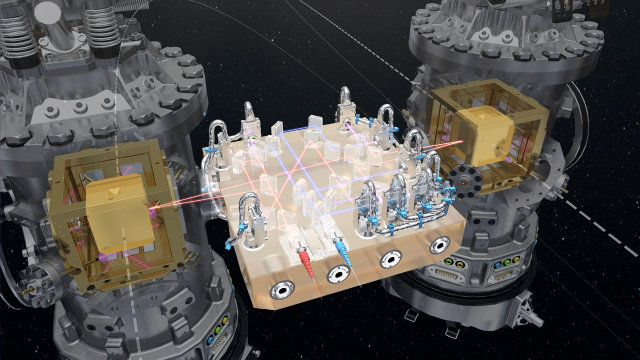
Illustration of the device in the LISA Pathfinder space probe (Image ESA/ATG medialab)

Yesterday ESA held a press conference to announce the results of the LISA Pathfinder space probe’s tests. This demonstration mission of the technologies needed to detect gravitational waves in space has been called a success beyond expectations. The mission team scientists published an article in the journal “Physical Review Letters” which describes the test results.

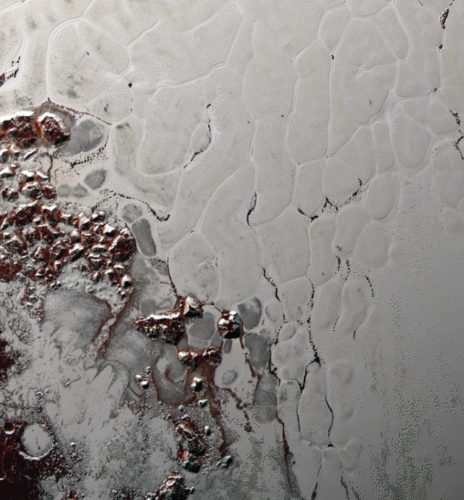
An area about 400 km (250 miles) long in Pluto's Sputnik Planum region (Image NASA/JHUAPL/SwRI)

Two articles published in the journal “Nature” describe a research about the heart-shaped geological formation on the dwarf planet Pluto. NASA’s New Horizons mission scientists determined various characteristics of the area, informally called Sputnik Planum, explaining that a phenomenon called convection renews its surface over time. Using the images taken by the New Horizons space probe, another research revealed new details on Pluto’s atmosphere.

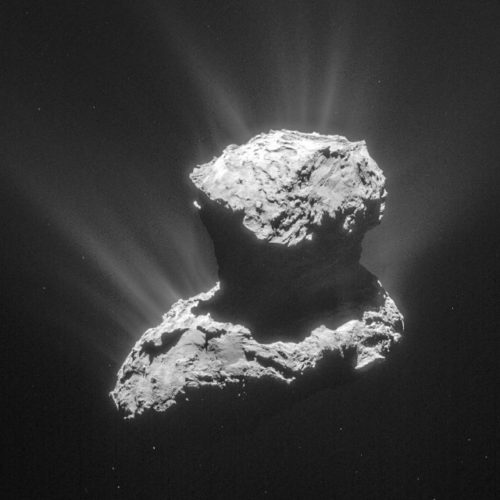
The comet 67P/Churyumov-Gerasimenko photographed on March 25, 2015, one of the moments of the organic molecules detections (Photo ESA/Rosetta/NavCam – CC BY-SA IGO 3.0)

An article published in the journal “Science Advances” describes the discovery of ingredients that are considered key to the origin of life on Earth on the comet 67P/Churyumov-Gerasimenko. In particular, glycine, an amino acid found in proteins, and phosphorus, an element that forms DNA and cell membranes. These observations were made by the ROSINA instrument aboard ESA’s Rosetta space probe.

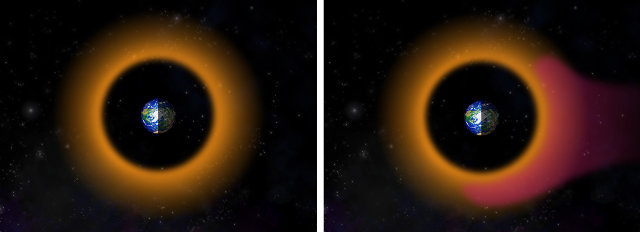
The ring current during quiet time (left) and during a geomagnetic storm (right) (Image Johns Hopkins APL)

An article published in the journal “Geophysical Research Letters” describes a research on the behavior of the ring of particles that surrounds the Earth. Using the measurements taken by the RBSPICE instrument aboard one of NASA’s Van Allen space probes it was possible to establish that high-energy protons in the ring current behave completely different from low-energy protons. It’s a step forward in the understanding of the Earth’s magnetosphere and therefore of the effects it may have on satellites and even the Earth’s surface.

The area that includes Chryse Planitia, Acidalia Planitia and Arabia Terra (a,c) with the close-up of a promontory (c) (Image J. Alexis Palmero Rodriguez)

An article published in the journal “Nature” presents a study that describes two possible mega-tsunamis that shook the surface of the planet Mars more than three billion years ago. According to a team led by J. Alexis Palmero Rodriguez of the Planetary Science Institute two meteorites hit Mars a few million years from each other but with similar effects. Perhaps at that time there was an ocean of liquid water and the impacts raised waves up to 120 meters (almost 400 fett) which engulfed large areas of the mainland.