Space Probes

The area around Ahuna Mons on Ceres photographed by the Dawn space probe (Image NASA/JPL-Caltech/UCLA/MPS/DLR/IDA)

Between March 6 and 7, 2015, depending on your time zone on Earth, NASA’s Dawn space probe entered the orbit of the dwarf planet Ceres. In December 2015 it went down to a lower altitude to conduct a mapping with the best definition and in February 2016 its orbital path led it into a position where it could take excellent pictures of Ahuna Mons, as they called the mountain that used to look like a pyramid and is one of the most curious geological features on Ceres.

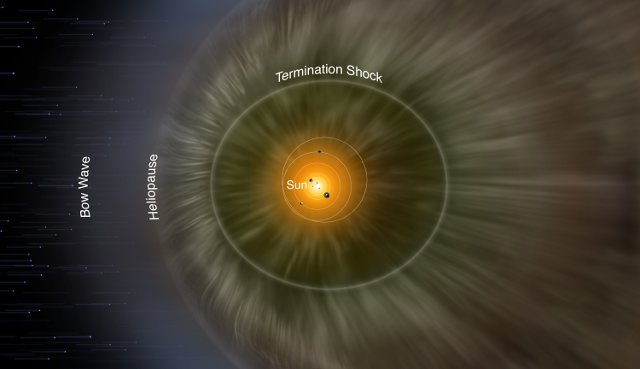
Artistic representation of the heliosphere with its heliopause and termination shock (Image NASA/IBEX/Adler Planetarium)

An article published in the journal “Astrophysical Journal Letters” describes a study that used data from NASA’s IBEX space probe and various simulations of the boundary of the magnetic bubble called the heliosphere, created by the flow of particles emitted by the Sun, to improve our knowledge of the interstellar magnetic field. In particular, this study sought to determine the strength and direction of the magnetic field outside the heliosphere to understand the forces acting in the galactic neighborhood.

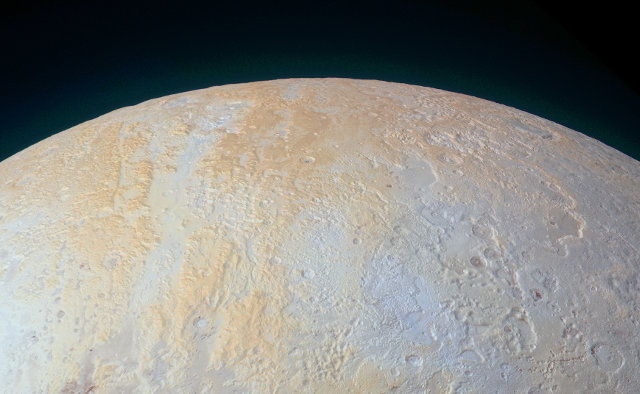
The area around Pluto's North Pole (Image NASA/JHUAPL/SwRI)

NASA’s New Horizons space probe sent photographs of the area around the dwarf planet Pluto’s north pole taken during the extraordinary July 14, 2015 flyby. The images reveal a series of canyons long and wide in the polar area that at its bottom is about 1,200 km (750 miles) wide. It’s part of the region informally called Lowell Regio after the astronomer Percival Lowell, the founder of the observatory where Pluto was discovered.

Charon's surface and in particular the area called Serenity Chasma (Image NASA/JHUAPL/SwRI)

The analysis of the photographs of Charon, the largest of Pluto’s moons, suggests that once it had an underground ocean that at some point froze causing the expansion of its surface layer. That event could explain the presence of a very long fracture on its surface, a kind of huge scar that devastates its equator.

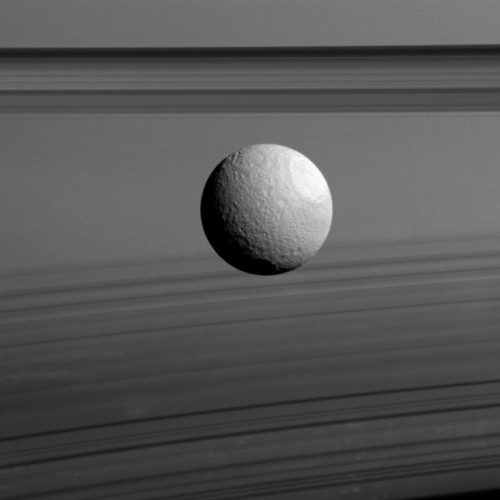
Saturn's moon Tethys with the planet's rings in the background (Image NASA/JPL-Caltech/Space Science Institute)

NASA has published a photograph taken by the Cassini space probe that frames Tethys, one of Saturn’s moons, in front of the planet’s rings. They have such a relative position Tethys seems to float between two sets of rings but it’s just an optical effect. The result is a particularly striking image even by the standards of a mission that has been offering stunning portraits of the planet Saturn, its rings and its moons.