Space Probes

Titan with Sinlap crater in the pane seen at different wavelengths (Image NASA/JPL-Caltech/University of Arizona/LPGNantes)

At the 47th Lunar and Planetary Science Conference held last week in The Woodlands, Texas, the latest news about the mountains of Titan, the largest of Saturn’s moons, were presented. NASA also presented the progress made in creating maps of this moon, a task that has to face a number of problems. All these works are based on data collected by the Cassini space probe.

Color global map of Ceres (Image NASA/JPL-Caltech/UCLA/MPS/DLR/IDA)

At the 47th Lunar and Planetary Science Conference held last week in The Woodlands, Texas, new results were presented of the analyzes of data collected about the dwarf planet Ceres by NASA’s Dawn space probe. Some of the mission scientists presented a new color map of Ceres surface and new highly detailed pictures of Occator crater, famous for the presence of the largest among the white spots, but also other interesting craters, especially Oxo, where water was found.

An article published in “The Astrophysical Journal Letters” describes an analysis conducted on data collected by ESA’s Rosetta space probe’s ROSINA instrument that allowed to established that the ice on the comet 67P/Churyumov-Gerasimenko has a crystalline form. It may seem a trivial problem, however such nature implies that it originated in the protosolar nebula and is as old as the solar system.

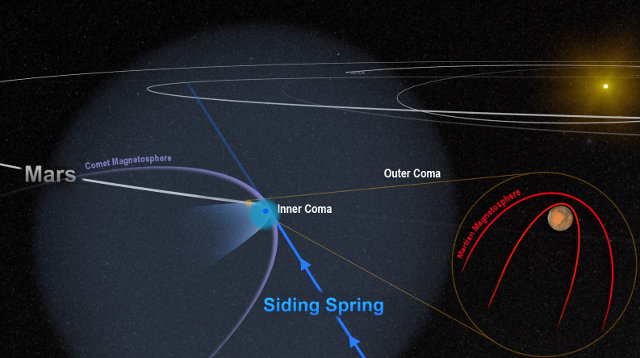
Scheme of the comet C/2013 A1 Siding Spring passing near Mars (Image NASA/Goddard)

An article published in the journal “Geophysical Research Letters” describes the effects on the planet Mars’ magnetic field caused by the close passage of the comet C/2013 A1 Siding Spring in October 2014. Using data collected in that period by NASA’s MAVEN space probe it was possible to reconstruct the moments that were chaotic for the Martian magnetosphere with profound consequences even if temporary.