Space Probes

Haulani Crater on Ceres (Image NASA/JPL-Caltech/UCLA/MPS/DLR/IDA)

NASA released new photos of various craters on the dwarf planet Ceres taken from its Dawn space probe, currently in its lowest orbit at an altitude of 385 kilometers (240 miles). From there, Dawn is making the most detailed mapping of Ceres and is providing really interesting details of craters that had already attracted the attention of scientists such as Haulani and Oxo.

The huge Y-shaped discontinuity on Enceladus' surface (Image NASA/JPL-Caltech/Space Science Institute)

A photograph taken by the Cassini space probe shows a huge system of fractures that have a shape similar to a letter Y on the surface of Enceladus, Saturn’s moon become in recent years one of the most interesting objects of astronomical studies. Called “Y-shaped discontinuities”, these elements of Enceladus’ icy surface are probably relatively young revealing the existing geological activity on this moon.

Image showing Milky Way, local interstellar cloud, the solar system and Cassini near Saturn (Image ESA; dust grain inset: NASA/JPL; Saturn image: NASA/JPL/Space Science Institute)

An article published in the journal “Science” describes the analysis of the composition of interstellar dust that entered the solar system and was intercepted by the Cassini space probe. Among the instruments on board there’s the Cosmic Dust Analyser (CDA), which over the years of its mission has collected millions of dust samples: 36 of them were found to be of interstellar origin.

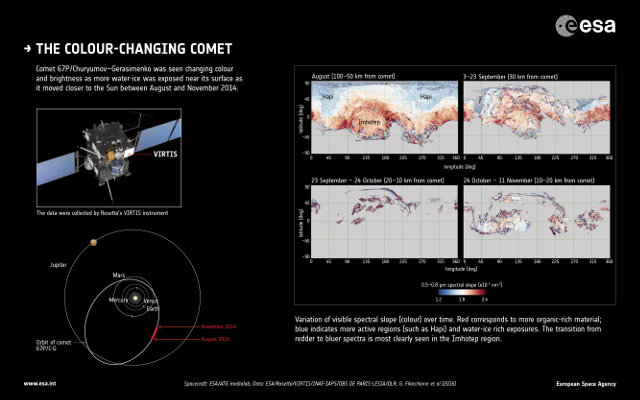
The colors changing on the surface of the comet 67P/Churyumov-Gerasimenko (Image ESA/ATG medialab; Data: ESA/Rosetta/VIRTIS/INAF-IAPS/OBS DE PARIS-LESIA/DLR; G. Filacchione et al (2016))

An article published in the journal “Icarus” describes the change in colors and brightness found on the surface of the comet 67P/Churyumov-Gerasimenko by ESA’s Rosetta space probe. These are the first findings of a study and concern the months immediately following Rosetta’s arrival in the comet’s orbit, in August 2014.

Stephen Hawking and his daughter Lucy in 2008 at NASA's 50th anniversary (Image NASA/Paul Alers)

Yesterday, at a press conference, the Russian entrepreneur Yuri Milner officially announced the Starshot project that aims to build interstellar probes. The idea is to create tiny probes with a sail driven by a laser operated from Earth so they can reach 20% of the speed of light to reach the Alpha Centauri system in just over two decades. The physicist Stephen Hawking and Facebook creator Mark Zuckerberg support the project.