Space Probes

Illustration of our traditional view of the Van Allen belts (Image NASA Goddard/Duberstein)

An article published in “Journal of Geophysical Research” describes a study on the Van Allen belts, two donut-shaped energetic formations surrounding the Earth. Two twin spacecraft originally called the Radiation Belt Storm Probes (RBSP) and later Van Allen probes were launched by NASA on August 30, 2012 to study the belts and are allowing us to learn a lot about them. The latest discovery concerns the variability of their shape.

Photos of the Imhotep region on the comet 67P/Churyumov-Gerasimenko where water ice on the surface was confirmed (Image ESA/Rosetta/NavCam – CC BY-SA IGO 3.0)

An article published in the journal “Nature” describes research that led to the confirmation of the presence of water ice exposed on the surface of the comet 67P/Churyumov-Gerasimenko. The VIRTIS instrument on ESA’s Rosetta space probe recorded the data that were analyzed to determine the composition of the surface top layer, which is mainly a dark material, dried and rich in organic substances containing a small part of water ice. On the comet there’s a lot of ice but it’s interesting to examine that on the surface because it allows us to understand better some of its creation processes, even underground.

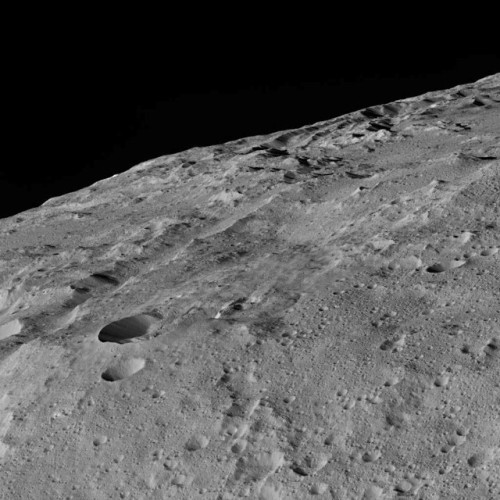
Picture of the area called Gerber Catena with its craters, depression and fractures (Image NASA/JPL-Caltech/UCLA/MPS/DLR/IDA)

Nearly three weeks ago NASA’s Dawn space probe reached its final orbit, at an altitude of about 380 kilometers (240 miles) over the dwarf planet Ceres. It will remain there indefinitely, meaning that it will keep that orbit until the end of its mission but at that point it won’t be moved. It’s its lowest orbit and from there Dawn immediately started taking the most detailed pictures and make new detections with its instruments.

Photo of Enceladus' northern region showing the contrast between its areas (Image NASA/JPL-Caltech/Space Science Institute)

Some days ago, the Cassini space probe completed its last Enceladus flyby. It’s a Saturn’s moon very interesting for the presence of an underground ocean of liquid water. This time, Cassini passed about 5,000 kilometers (about 3,100 miles) from Enceladus measuring the heat flow from inside it and taking more pictures of its icy surface.

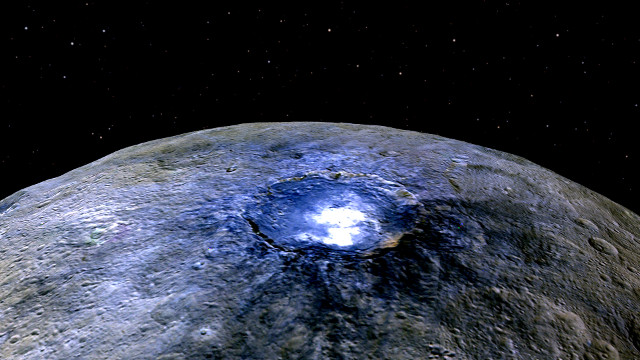
Occator Crater in falso colors stressing the white spots (Image NASA/JPL-Caltech/UCLA/MPS/DLR/IDA)

Two studies published in the journal “Nature” offered new interesting information about the dwarf planet Ceres. Thanks to analyzes of data collected by NASA’s Dawn space probe the authors of these studies claim that the mysterious white spots are composed of salts and that on Ceres there are ammonia-rich clays. The explanations about the materials that make up the white spots may solve a mystery while the presence of ammonia creates another, linked to the origin of this dwarf planet.