Space Probes

Artistic concept of the Akatsuki space probe orbiting Venus (Image courtesy JAXA. All rights reserved)

JAXA, the Japanese space agency, confirmed that its space probe Akatsuki has successfully accomplished the maneuvers to allow it to enter the orbit of the planet Venus. These maneuvers took place exactly five years after the failure of the first attempt. The orbit is significantly different from the one programmed for the mission and JAXA engineers are assessing it to schedule some additional maneuvers. However, there’s optimism about the possibility of carrying out the scientific mission Akatsuki was built for.

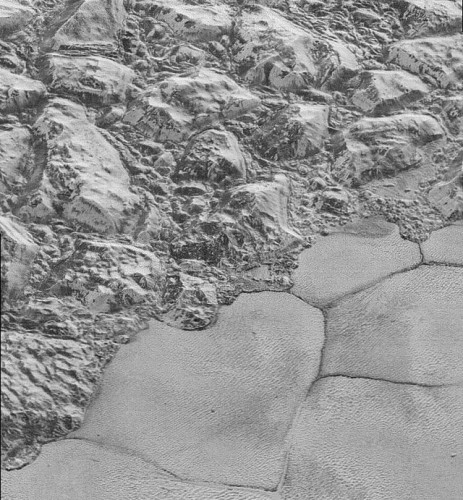
One of the very high resolution pictures of Sputnik Planum on Pluto (Image NASA/JHUAPL/SwRI)

NASA released the first very high resolution photographs showing close-ups of ​​the dwarf planet Pluto’s surface. These are images captured by the New Horizons space probe during its extraordinary July 14, 2015 flyby. In recent months, NASA already received high-resolution photographs but these ones are part of a series of shots that was intended to capture the details of Pluto’s surface, in this case the area called Sputnik Planum.

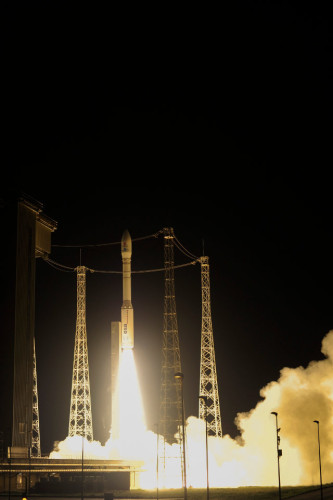
The LISA Pathfinder space probe blasting off atop a Vega rocket (Photo ESA–Stephane Corvaja)

A few hours ago ESA’s LISA Pathfinder space probe was successfully launched atop a Vega rocket from the Kourou space center in French Guiana. After about an hour and 45 minutes it separated from the rocket’s upper stage and activated to begin its long journey thanks to its propulsion module.

LISA Pathfinder entered an elliptical orbit where it will make a series of maneuvers that within a few weeks will take it to the area called L1, where the gravity of the Earth and the Sun get balanced with the other forces acting on the probe. The propulsion module will be disconnected after exhausting its function and the probe will remain in the L1 area, about 1.5 million kilometers (about 900,000 miles) from Earth.

Scheme of carbon exchange and loss processes on Mars (Image Lance Hayashida/Caltech)

An article published in the journal “Nature Communications” offers an explanation to the loss of carbon in the planet Mars’ atmosphere. A team of scientists from CalTech (California Institute of Technology) and NASA’s Jet Propulsion Laboratory studied the available data focusing on the problem of carbon because what remained is less than expected even taking into account the recent results on the red planet’s atmosphere loss.

Aurorae Chaos and Ganges Chasma (Image ESA/DLR/FU Berlin, licence CC BY-SA 3.0 IGO)

ESA has published images of Valles Marineris on Mars captured by its Mars Express space probe in July 2015. It’s a huge complex of geological fractures much wider and longer than the American Grand Canyon. In particular, scientists focused on the photographs taken by Mars Express’ High Resolution Stereo Camera (HRSC) in an area called Aurorae Chaos, where there are still traces of ancient water flows.