Telescopes

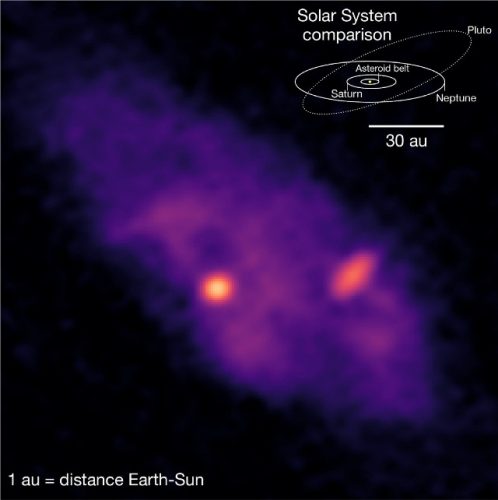
The protostars in IRAS 16293-2422 A

An article accepted for publication in “The Astrophysical Journal” reports observations of a pair of protostars in a system in its formation phase cataloged as IRAS 16293-2422 A. A team of researchers from the astrochemistry group of the Max Planck Institute for Extraterrestrial Physics (MPE) in Munich, Germany, used the ALMA radio telescope to study the two protostars, cataloged as A1 and A2, since it can detect the emissions not filtered by the materials that surround them, also forming the circumstellar disks from to which planets may form in the future. The two protostars are in the initial phase of their formation and are still surrounded by the molecular cloud that constitutes the source of the gas and dust that are forming them.

Some stars and planets situations

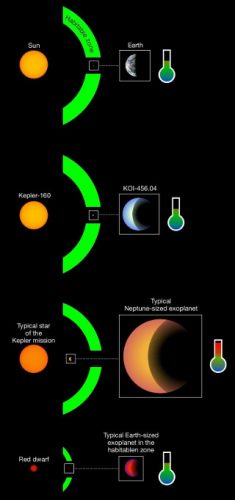
An article published in the journal “Astronomy & Astrophysics” reports the discovery of an exoplanet candidate with a very high probability of existence, a super-Earth designated as KOI-456.04 whose estimated year is slightly longer than the Earth’s that orbits Kepler-160, a Sun-like star. A team of researchers led by RenĂ© Heller of the Max Planck Institute for Solar System Research in Göttingen, Germany, analyzed old data accumulated by the Kepler space telescope using a new method based on the detailed physical model of the stellar brightness variation instead of the classic one based on the search for the tiny drops in brightness that occur when the planet passes between the star and the telescope. The analysis also led to the discovery of another exoplanet candidate designated as Kepler-160 d.

Artist's concept of W1200-7845 with its protoplanetary disk (Image NASA/William Pendrill)

At the 236th Meeting of the American Astronomical Society (AAS) held in recent days, on this occasion virtually and not in a physical place due to the Covid-19 pandemic, the discovery of the youngest brown dwarf of our cosmic neighborhood was announced. Named W1200-7845, it’s so young that it has a protoplanetary disk, a really interesting discovery because it will allow to study a possible planetary formation around an object that can be considered a failed star. This result came thanks to the Disk Detective program, which allows citizen scientists to examine astronomical images captured by NASA’s WISE space telescope, looking for protoplanetary disks. Its discovery allowed to conduct follow-up observations to study its evolution.

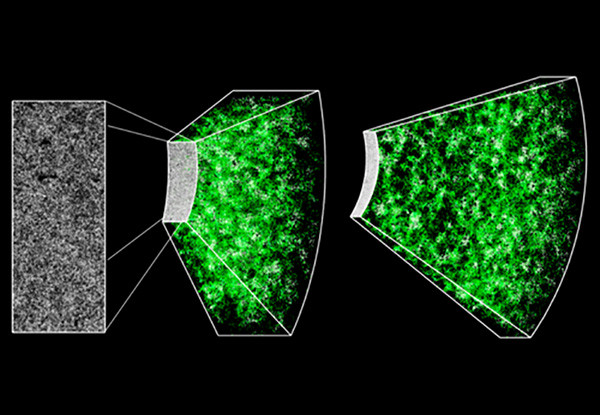
A section of the three-dimensional map of the galaxies of the Sloan Digital Sky Survey used for the analysis

An article published in the journal “Physical Review Letters” reports a new estimate of the expansion of the universe based on the large cosmic structures formed by galaxies. A team of researchers led by Dr. Seshadri Nadathur of the British University of Portsmouth’s Institute of Cosmology and Gravitation (ICG) used data about over one million galaxies and quasars collected over a decade by the Sloan Digital Sky Survey to create an analysis that provided a measure of the effects of the mysterious dark energy that’s accelerating the expansion of the universe. Adding a new method of its calculation doesn’t necessarily lead to the right value, but can help understand why other methods provide incompatible results and where we might need to expand our knowledge of physics to obtain the right value.

Artistic representation of an extreme horizontal branch star with a giant star spot

An article published in the journal “Nature Astronomy” reports a study on stars of a particular type since they’re much smaller than the Sun but much hotter and therefore blue. A team of researchers led by Yazan Al Momany of the Italian National Institute of Astrophysics, Padua, used various instruments on ESO’s Very Large Telescope (VLT) and NTT (New Technology Telescope) in Chile to study stars of that type discovering the equivalent of sunspots but even three thousand times larger in size. In some of these spots, flares have been observed that are millions of times more intense than the Sun’s which indicate the presence of very intense magnetic fields.