Telescopes

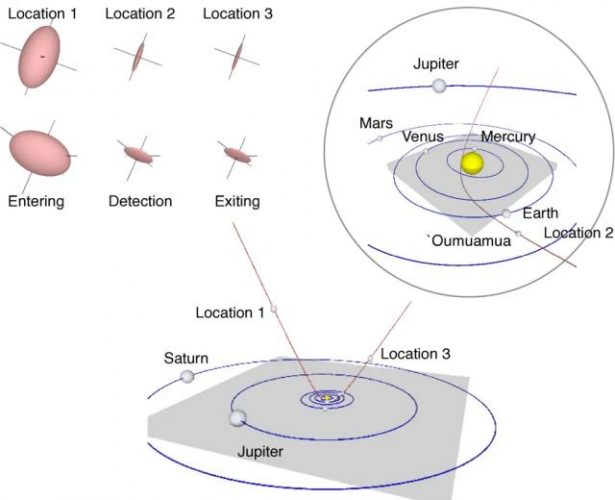
A diagram of the evolution of the interstellar asteroid 'Oumuamua's size and shape

An article accepted for publication in the “Astrophysical Journal Letters” reports a study on the interstellar asteroid 1I/2017 U1 / ‘Oumuamua that offers an explanation for its strange properties. Professor Gregory Laughlin of the University of Yale and Dr. Darryl Seligman of the University of Chicago examined the data collected during the various observations of ‘Oumuamua concluding that it could contain a significant percentage of hydrogen ice and could have originated in the heart of a molecular cloud.

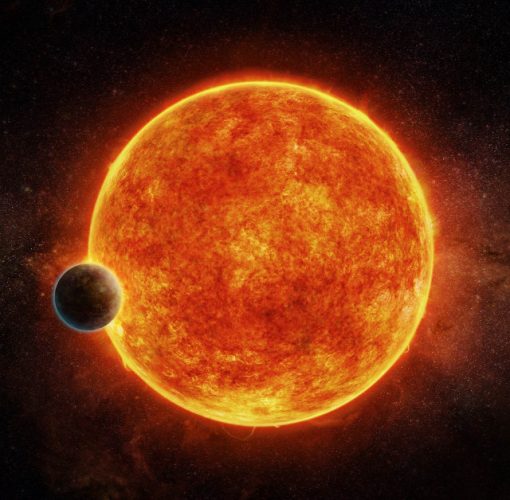
Artist's concept of a super-Earth with its star behind it (Image courtesy M. Weiss/CfA)

An article accepted for publication in the journal “Astronomy & Astrophysics” reports the discovery of a super-Earth in the system of HD 164922, a star that’s slightly smaller and slightly less massive than the Sun. A team of researchers led by Serena Benatti of the Italian National Institute for Astrophysics, Palermo, used the HARPS-N spectrograph installed on the Galileo Telescope, on the Canary Islands, to collect the data which, together with others previously collected with other instruments, allowed to discover the exoplanet designated as HD 164922d. The discoveries of exoplanets are increasingly made thanks to software that performs an automatic analysis of data collected by various telescopes, but in this case it’s the prize for the tenacity of astronomers who put together the data of years of observations conducted with various instruments.

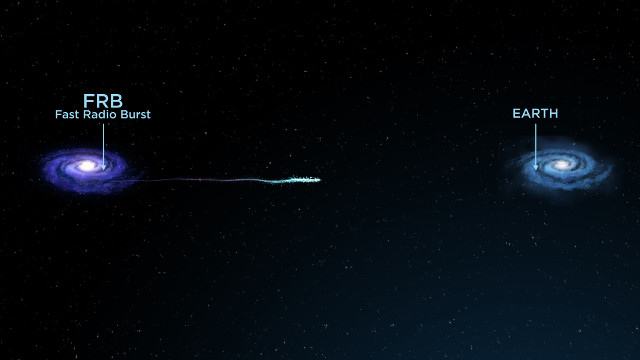
An FRB's journey to Earth (Image courtesy ICRAR)

An article published in the journal “Nature” reports a measurement of the amount of the so-called baryonic matter, ordinary matter, in the universe analyzing the characteristics of fast radio bursts (FRBs). A team of researchers led by Professor Jean-Pierre Macquart from the Curtin University node of the International Centre for Radio Astronomy Research (ICRAR), used detections carried out using the ASKAP radio telescope, which allowed to determine the position of the FRBs in the galaxies that host them with considerable precision. By analyzing their characteristics it was possible to determine the density of matter between their point of origin and the Earth.

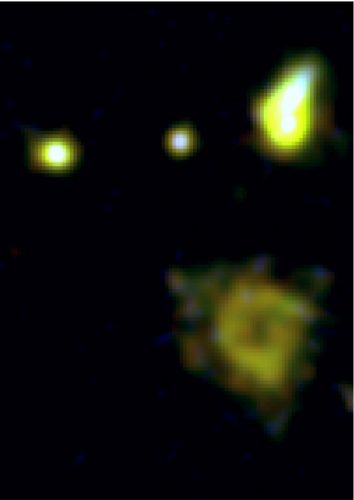
Galaxy R5519 (Image courtesy Tiantian Yuan/Hubble Space Telescope)

An article published in the journal “Nature Astronomy” reports the study of a very rare type of galaxy, called a cosmic ring of fire. A team of researchers led by Dr. Tiantian Yuan from Australia’s ARC Centre of Excellence for All Sky Astrophysics in 3 Dimensions (ASTRO 3D) used spectroscopic images obtained at the Keck Observatory in Hawaii and images captured by the Hubble Space Telescope to identify the strange structure of the galaxy officially designated as R5519. It’s an ancient galaxy, and its discovery may require new changes to current galactic formation models.

Wolfe Disk seen by ALMA

An article published in the journal “Nature” reports a study on the galaxy nicknamed Wolfe Disk that shows that it formed very early, to the point that it already had the shape of a disk galaxy about 1.5 billion years after the Big Bang. A team of researchers used the ALMA radio telescope to study this galaxy and find evidence of its characteristics that make it the oldest with a rotating disk found so far. Its existence so early in the history of the universe poses a problem for the current galactic formation models.