Telescopes

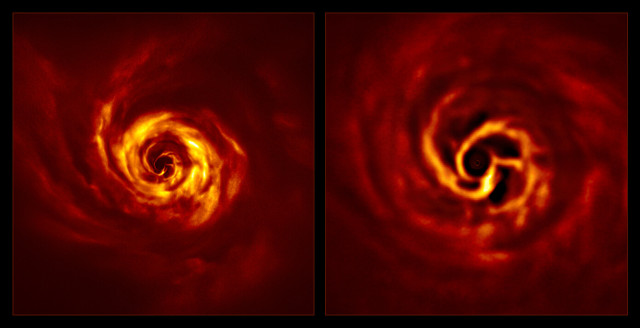
The AB Aurigae system seen by SPHERE

An article published in the journal “Astronomy & Astrophysics” reports evidence of the existence of a planet in formation in the protoplanetary disk surrounding the young star AB Aurigae. A team of researchers led by Anthony Boccaletti, of the Observatoire de Paris, PSL University, France, used the SPHERE instrument mounted on ESO’s VLT in Chile to find traces of what could be a planet. SPHERE takes real photos of the objects, so if the discovery was confirmed it would be the first direct evidence of a planet seen while it’s forming.

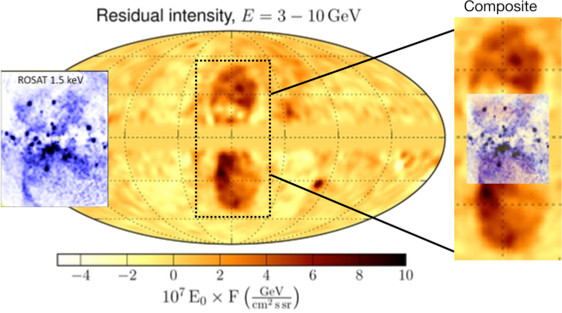
Gamma-ray and X-ray observations of the center of the Milky Way

An article published in “The Astrophysical Journal” offers an explanation of the origin of the so-called Fermi bubbles, the two gigantic gas bubbles existing above and below the center of the Milky Way. Guo Fulai and Zhang Ruiyu of the Shanghai Astronomical Observatory (SHAO) of the Chinese Academy of Sciences conducted a series of simulations that allowed to create a model that explains the origin of the Fermi bubbles and at the same time of the biconical X-ray structure at the center of the galaxy. According to the new model, the two phenomena are caused by shock waves generated by two jets from Sagittarius A*, or simply Sgr A*, the supermassive black hole at the center of the Milky Way, around 5 million years ago.

Artist's concept of the TRAPPIST-1 system (Image courtesy NAOJ)

An article published in “The Astrophysical Journal Letters” reports a study on the alignment of the ultra-cool dwarf star TRAPPIST-1 with its system’s 7 planets. A team of researchers led by Teruyuki Hirano of the Tokyo Institute of Technology used the Subaru telescope on Mount Mauna Kea, Hawaii, to observe that system not finding a significant misalignment of the planets with respect to their star. The astronomers who conducted the study warn that the measurements’ accuracy is not enough to completely rule out a small misalignment, but the result is significant in the study of the evolution of very small stars’ planetary systems.

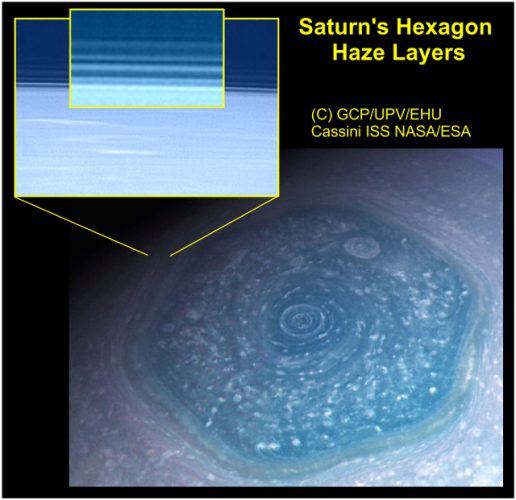
Saturn's hexagon and its layers

An article published in the journal “Nature Communications” reports a study on the stratification of the hexagonal structure of the gigantic hurricane that occupies the planet Saturn’s north pole. A team of researchers led by Professor Agustín Sánchez-Lavega of the University of the Basque Country used data collected by the Cassini space probe and the Hubble space telescope to understand that it’s a system composed of at least seven layers of haze with an extension of over 300 kilometers. The study also allowed to discover that those layers contain microscopic frozen particles composed of hydrocarbons such as acetylene, propane, propine, diacetylene, and butane.

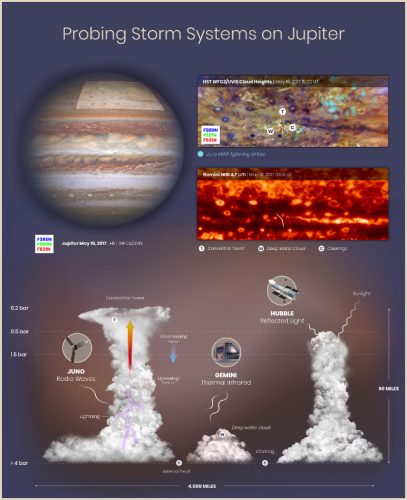
A graphic of the combined observations of Jupiter

An article published in “The Astrophysical Journal Supplement Series” reports the results of a series of combined observations of the planet Jupiter. A team of researchers led by Michael Wong of the University of California, Berkeley, used data collected by the Hubble Space Telescope, the Gemini Observatory in Hawaii and NASA’s Juno space probe to obtain a broader picture of various phenomena taking place in Jupiter’s atmosphere. Storms include the Great Red Spot, which the combined observations help us understand better.