Telescopes

Filaments (in blue) that connect the galaxies (in white) of the SSA22 cluster (Image courtesy Hideki Umehata)

An article published in the journal “Science” reports the discovery of massive gas filaments between the galaxies of a protocluster cataloged as SSA22 about 12 billion light years from Earth. A team of researchers coordinated by the RIKEN Cluster for Pioneering Research used the MUSE spectrograph mounted on the VLT in Chile and the Suprime-Cam on the Subaru telescope to map those filaments, which extend over more than 3 million light years. Follow-up observations that provided further details were conducted with the ALMA radio telescope and the Keck telescope. The filament gas can feed star formation and the growth of supermassive black holes in the protocluster. The observation of those processes can provide new information on the evolution of galaxies.

The protocluster z66OD with its galaxies in the insets (Image courtesy NAOJ/Harikane et al.)

An article published in “The Astrophysical Journal” reports the discovery of a galaxy protocluster dating back to about 13 billion years ago. A team of astronomers led by Yuichi Harikane of the National Astronomical Observatory of Japan (NAOJ), used the Subaru, Keck and Gemini telescopes to find a group of 12 early galaxies including a giant one nicknamed Himiko that form a precursor of today’s galaxy clusters cataloged as z66OD. Its study will help to better understand the evolution of these cosmic structures and the influences among the galaxies that form them, especially the more massive ones.

Artist's concept of tidal destruction event (Image NASA's Goddard Space Flight Center)

An article published in “The Astrophysical Journal” reports the study of an event cataloged as ASASSN-19bt in which a supermassive black hole destroyed a star that came too close to it. A team of researchers led by Patrick Vallely and Tom Holoien discovered the start of the event thanks to the ASAS-SN network, obtained observations thanks to the NASA TESS space telescope, which was aimed at that area, and conducted follow-up observations using NASA’s Swift and ESA’s XMM-Newton space telescopes and the network of ground-based Las Cumbres Observatories.

Six galaxies were observed as they became quasars in a very short time

An article published in “The Astrophysical Journal” reports the discovery of six galaxies with active galactic nuclei (AGN) which showed a remarkable change in their brightness within a few months becoming quasars. A team of researchers used data collected during the first nine months of the Zwicky Transient Facility (ZTF) survey to discover those galaxies that were classified as LINERs, fairly common galaxies that are generally bright but far from quasars. It could be a new kind of activity of the supermassive black holes at the center of those LINER galaxies.

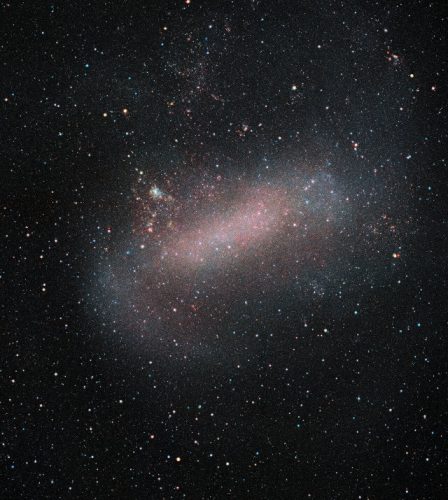
The VISTA telescope offers new details of the Magellanic Clouds

An article accepted for publication in the journal “Monthly Notices of the Royal Astronomical Society” reports the results of a study of the two Magellanic Clouds, satellite dwarf galaxies of the Milky Way. A team of researchers used data collected during the VISTA survey of the Magellanic Clouds system (VMC) exploiting the ability of ESO’s VISTA telescope to detect the near infrareds to show new details of the Magellanic Clouds.