Telescopes

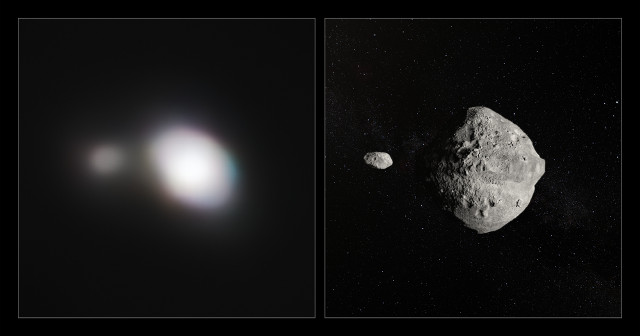
The asteroid 1999 KW4 photographed by the SPHERE instrument

ESO has published photos of the asteroid 1999 KW4 taken using the SPHERE instrument mounted on the VLT in Chile. This is part of a campaign of observations coordinated by the International Asteroid Warning Network (IAWN), which followed the UN recommendations to set up the control of potentially dangerous asteroids. 1999 KW4 passed 5.2 million kilometers from the Earth on May 25, 2019, an absolutely safe distance but it was a good opportunity to assess the possibility of keeping an eye on the trajectory of what’s actually a double asteroid even using an instrument designed to photograph exoplanets.

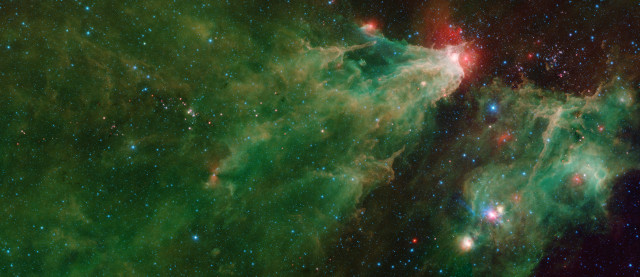
A stellar panorama between the Cepheus C and Cepheus B regions

An article published in “The Astrophysical Journal” reports a study of an area containing a number of star clusters that have a common origin even if their formation had slightly different timescales in the various regions. A team of researchers used NASA’s Spitzer space telescope and Chandra X-ray Observatory to examine the many different objects present between the regions known as Cepheus C and Cepheus B and map the cluster called Cep OB3b.

Artist's concept of the exoplanet NGTS4b and its star (Image courtesy University of Warwick/Mark Garlick)

An article published in the journal “Monthly Notices of the Royal Astronomical Society” reports the discovery of an exoplanet belonging to the mini-Neptune class in an orbit close to its star, where a planet of that type should not exist, so much that it’s called Neptunian Desert. A team of astronomers coordinated by the University of Warwick used the Next-Generation Transit Survey (NGTS) array in Chile to locate the exoplanet, which was therefore cataloged as NGTS-4b. It may have got closer to its star or was originally larger but part of its atmosphere was consumed by stellar radiation.

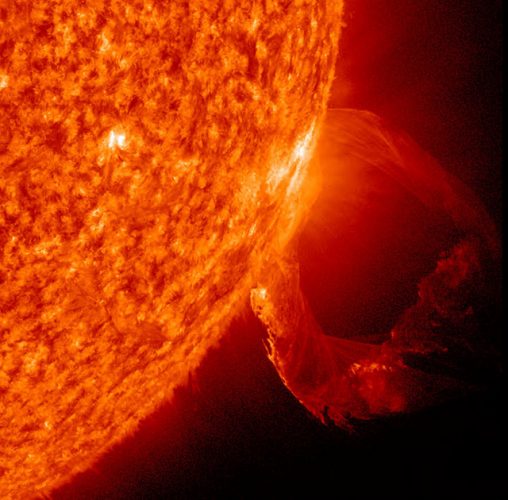
A solar eruption (Image SDO/NASA)

An article published in the journal “Nature Astronomy” reports the observation of a huge coronal mass ejection (CME), a huge stellar eruption in which an enormous amount of materials is thrown out, by the star HR 9024. A team of researchers led by Constance Argiroffi of the University of Palermo and associated of the National Institute of Astrophysics used data collected by NASA’s Chandra X-ray Observatory to find traces of the ejection of a mass about 10,000 times greater than that of the most powerful events of that kind generated by the Sun.

New clues to the origin of fast radio bursts in neutron stars

An article published in the journal “Astronomy & Astrophysics” reports a study of the data about 43 fast radio bursts (FRBs) that offers new clues to their origin in neutron stars. A team of Italian researchers associated with the National Institute of Astrophysics used observations made with the ASKAP and Parkes radio telescopes, adapting a test from the 1960s to try to establish their distribution by comparing it with that of stars. The results gave some surprises and are not conclusive, but a method was offered that could be the key to solving the mystery for good.