
Telescopes

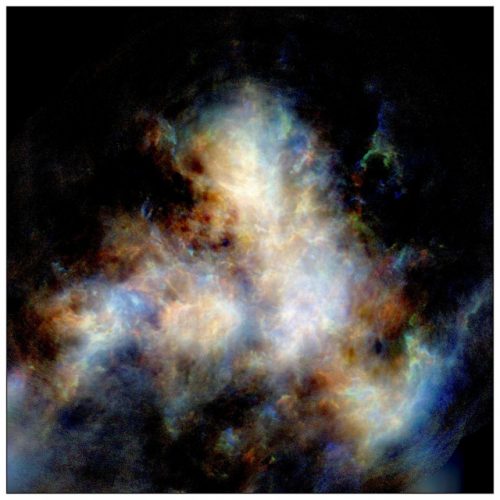
Hydrogen in the Small Magellanic Cloud (Image courtesy Naomi McClure-Griffiths et al, CSIRO's ASKAP telescope. All rights reserved)

An article published in the journal “Nature Astronomy” describes the study of a gas outflow from the Small Magellanic Cloud that extends for at least 6,500 light years from its star formation area. A team of researchers used the ASKAP radio telescope to observe that dwarf galaxy in its entirety in a single shot with details never seen before. The conclusion is that there’s a gas loss resulting in a drop in star formation. That gas could be a source for what is known as Magellanic Stream and over time the Small Magellanic Cloud could be devoured by the Milky Way.

The origin of star clusters observed thanks to the SOFIA airborne telescope

An article published in the journal “Monthly Notices of the Royal Astronomical Society” describes the study of molecular clouds where new star clusters form. A team of researchers used the SOFIA airborne telescope exploiting its ability to detect infrareds coming from dark clouds where the first stages of star formation are hidden. The observations offered new evidence that star clusters form as a result of collisions between giant molecular clouds.

Galaxy mergers reveal pairs of supermassive black holes

An article published in the journal “Nature” describes the discovery of five pairs of supermassive black holes in galaxies in the final stages of mergers. A team of researchers coordinated by the University of Maryland used data gathered at the Keck Observatory in Hawaii and in over twenty years by the Hubbble space telescope to find out these cases among hundreds of galaxies selected from those with strong X-ray emissions detected by the Swift space telescope.

Abell 2597 seen by ALMA (yellow), MUSE (red) and Chandra (blue-purple) (Image ALMA (ESO/NAOJ/NRAO), Tremblay et al.; NRAO/AUI/NSF, B. Saxton; NASA/Chandra; ESO/VLT)

An article published in “The Astrophysical Journal” describes the observation of a sort of galactic fountain of cold molecular gas pumped by a supermassive black hole in the brightest galaxy of the galaxy cluster Abell 2597. A team of researchers used the ALMA radio telescope and the MUSE spectrograph mounted on ESO’s VLT to observe for the first time a cycle that includes both inflow and outflow that powers that fountain.

The 2MASS J18082002-5104378 system in the rectangle (Image courtesy ESO/Beletsky/DSS1 + DSS2 + 2MASS)

An article published in “The Astrophysical Journal” describes the discovery of a tiny star whose age was estimated at around 13.5 billion years, making it one of the oldest stars in the universe. A team of astronomers studied the star known only as 2MASS J18082002-5104378 B, whose mass is only 14% of the Sun’s, and in particular its composition discovering the very low metal content. The conclusion is that it’s almost completely formed from materials created after the Big Bang.