Telescopes

Simulation of materials near Sagittarius A* (Image ESO/Gravity Consortium/L. Calçada)

An article published in the journal “Astronomy & Astrophysics” describes the detection of very hot gas clouds that orbit the supermassive black hole at the center of the Milky Way, called Sagittarius A* or simply SgrA*. A team of researchers used the GRAVITY instrument installed on ESO’s VLT to observe infrared light flares coming from the gas and dust accretion disk that orbits SgrA* at very high speed. These are the most accurate observations of materials so close to a black hole’s event horizon.

Artist's concept of the Kepler space telescope with some of the systems it observed (Image NASA)

NASA announced the end of its Kepler space telescope’s mission after it ran out of the fuel it needs to aim it towards the various areas of the sky to be observed. This event isn’t a surprise because in August 2018 problems with its thrusters had already started due to the scarcity of hydrazine used as fuel. Now it’s been “parked” in its heliocentric orbit in which it orbits the Sun and being a stable orbit it will keep on doing so for a very long time.

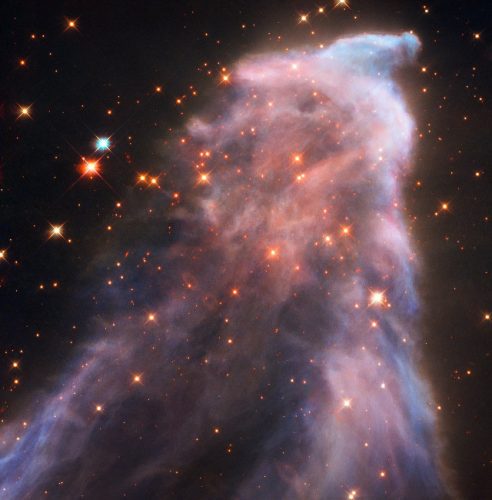
IC 63 (Image ESA/Hubble, NASA)

An image captured by the Hubble Space Telescope shows a nebula known as IC 63 and nicknamed the Ghost Nebula or the Ghost of Cassiopeia for its ghostly appearance generated by the transparencies in the gas and dust it contains. It looks suitable for the upcoming Halloween celebrations but it will not last forever because a star called Gamma Cassiopeiae is slowly wiping out that gas with its powerful emissions.

NGC 2467 seen by FORS2 (Image ESO)

ESO has published a photo of the nebula NGC 2467, also known as the Skull Nebula, taken using the FORS2 instrument mounted on the VLT in Chile. It’s a stellar nursery as it contains a lot of gas that’s still forming a number of new stars and consequently sees a predominance of young, often massive, stars. The photo was taken as part of ESO’s Cosmic Gems programme, which has also an educational purpose.

A new study of the youngest pulsar discovered in the Milky Way

An article published in the journal “The Astrophysical Journal” describes the study of a pulsar cataloged as PSR J1846-0258 found among the remnants of a supernova called Kes 75. A team of researchers used information collected with NASA’s Chandra X-ray observatory between 2000 and 2016 to study the pulsar’s characteristics. They confirmed that it’s the youngest discovered in the Milky Way and could help to better understand that kind of objects, also because they discovered a pulsar wind nebula, a cloud of gas around it created thanks to a very elevated rotation and magnetic field.