Telescopes

Example of quasar (Image ESA/Hubble & NASA)

An article published in the journal “Publications of the Astronomical Society of Australia” describes the discovery of the fastest growing supermassive black hole. A team of astronomers from the Australian National University (ANU) used data collected by ESA’s Gaia space probe, NASA’s WISE space telescope and the SkyMapper telescope at the ANU Siding Spring Observatory to find it. It’s a quasar, one of the brightest objects in the universe but is more than 12 billion light years away from Earth. It swallows the equivalent of the Sun’s mass every two days.

Artist's impression of 2004 EW95 (Image ESO/M. Kornmesser)

An article published in the journal “The Astrophysical Journal Letters” describes the study of an asteroid cataloged as 2004 EW95 which confirmed it has anomalous characteristics, being the first in the Kuiper belt to show a considerable carbon content. A team of astronomers used ESO’s VLT to study an asteroid that probably formed in the belt between Jupiter and Mars before being pushed to the outer solar system.

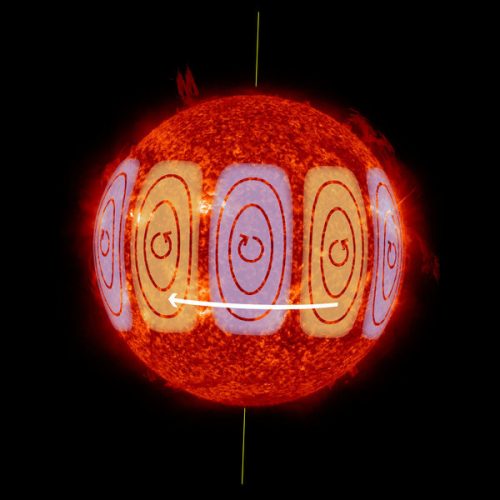
Diagram of solar Rossby waves (Image courtesy MPS/NASA/HormesDesign)

An article published in the journal “Nature Astronomy” describes the evidence of the presence of gigantic waves called Rossby waves on the Sun’s surface. A team of scientists led by the Max Planck Institute for Solar System Research (MPS) and the University of Göttingen discovered these vortices that have sizes comparable to those of the Sun itself, confirming a hypothesis that was proposed decades ago because they exist naturally in rotating fluids.

Artist's representation of WASP-96b (Image courtesy Engine House. All rights reserved)

An article published in the journal “Nature” describes a research on the exoplanet WASP-96b. It’s a hot Saturn, meaning a gas giant with a Saturn-like mass and an orbit close to its star which has as a consequece a high temperature on its surface. A team of researchers led by Nikolay Nikolov of the British University of Exeter used the FORS2 spectrograph mounted on ESO’s VLT to study WASP-96b discovering strong traces of sodium, an observation possible only in the absence of clouds in its atmosphere.

the W43-MM1 area (Image courtesy ESO/ALMA/F. Motte/T. Nony/F. Louvet/Nature Astronomy. All rights reserved)

An article published in the journal “Nature Astronomy” describes a research on a region of space about 18,000 light years from the Earth in which a remarkable star formation is being observed, cataloged as W43-MM1. A team of researchers used the ALMA radio telescope to study it and found that more massive stars are forming than predicted by current models.