Telescopes

The supernova SN 2001ig

An article published in “The Astrophysical Journal” describes the detection of a companion of the type IIb supernova known as SN 2001ig. A team of astronomers used the Hubble Space Telescope to discover the first case of a binary system in which one of the stars survived when its partner exploded into a supernova. The two stars were not just close but there was an interaction that had an influence on the supernova.

The SPT2349-56 proto-cluster (Image ESO/ALMA (ESO/NAOJ/NRAO)/Miller et al.)

Two articles, one published in the journal “Nature” and one in the journal “Astrophysical Journal”, describe the observations of the merger among various starburst galaxies, characterized by a remarkable production of stars. Two teams, led by Tim Miller of Dalhousie University in Canada and Yale University in the USA, and Iván Oteo of the Scottish University of Edinburgh used the ALMA and APEX radio telescopes to study these events which are very ancient as they happened about 1.5 billion years after the Big Bang.

The Lagoon Nebula at visible light (Image NASA, ESA, and STScI)

On April 24, 1990, the Hubble Space Telescope was launched on the Space Shuttle Discovery and put into orbit the next day. To celebrate the 28th anniversary of that event, which represents a milestone in the history of astronomy, new breathtaking photos of the Lagoon Nebula have been published.

About 4,000 light years away from the Earth, the Lagoon Nebula was first cataloged by the astronomer Giovanni Battista Hodierna and later included in other catalogs, so much so that it’s known by various designations including Messier 8 or M8, NGC 6523, Sharpless 25, RCW 146, and Gum 72. In optimal conditions it’s visible even to the naked eye, so it’s the object of observations by amateur astronomers as well.

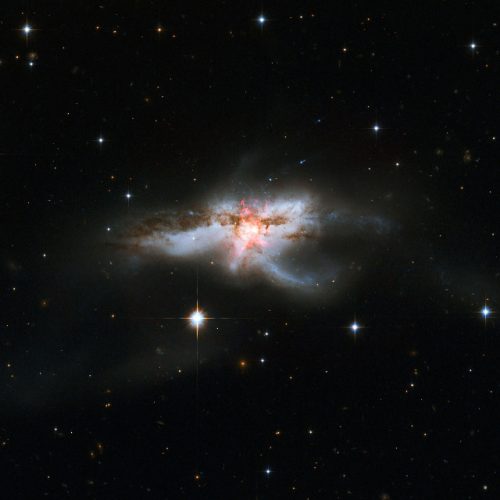
The galaxy NGC 6240 (Image NASA, ESA, the Hubble Heritage (STScI/AURA)-ESA/Hubble Collaboration, and A. Evans (University of Virginia, Charlottesville/NRAO/Stony Brook University))

An article published in the journal “Nature” describes a research on the formations similar to the wings of a butterfly in the galaxy NGC 6240. A team of researchers at the University of Colorado Boulder combined observations made with the Hubble Space Telescope, the VLT in Chile and the Apache Point Observatory in New Mexico to study that galaxy by concluding that those particular formations are generated by different forces, in one case by a pair of supermassive black holes.

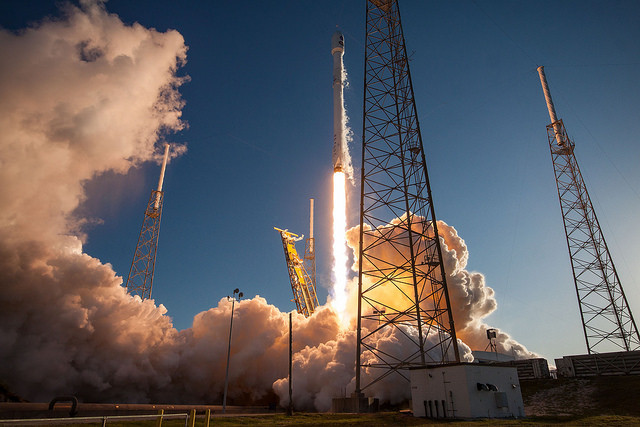
NASA's TESS space telescope blasting off atop a Falcon 9 rocket (Foto SpaceX)

A few hours ago NASA’s TESS space telescope blasted off atop a Falcon 9 rocket from Cape Canaveral. After almost 50 minutes it separated successfully from the rocket’s last stage and reached a transfer orbit where it will start a number of maneuvers that in about two months will take it to the very elliptical final orbit where it will begin its scientific mission.