Telescopes

The cosmic web in two moments

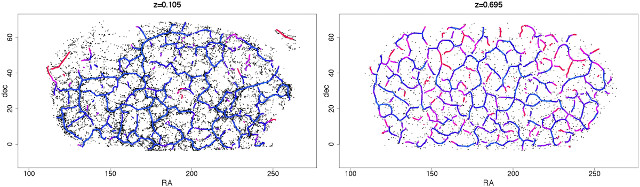
An article published in the journal “Nature Astronomy” describes the creation of a map of the network of filaments that connects matter all around the universe. A team of researchers analyzed the data collected during previous surveys to find the gravitational effects that reveal the shapes of those filaments. Those small gravitational distortions suggest that they’re hundreds of millions of light years long and that they’re made of dark matter.

Star systems observed by the SPHERE instrument (Image ESO/H. Avenhaus et al./E. Sissa et al./DARTT-S and SHINE collaborations)

Two articles, one published in the “Astrophysical Journal” and one in “Astronomy & Astrophysics”, describe two researches on a number of star systems. Two teams used the SPHERE instrument mounted on ESO’s VLT in one case to study dust and gas disks around a number of young stars in their formation stage and in the other case to study a pair of disks in a system with three stars.

The Horsehead Nebula

Two articles, one published in the journal “The Astronomical Journal” and one in the journal “Astronomy and Astrophysics”, describe as many researches on the Horsehead Nebula, iconic for its particular shape. Two teams of researchers used NASA’s SOFIA flying observatory to map the distribution of gas and dust connected to the star formation activity within it.

The supernova remnants 1E 0102.2-7219

An article published in the journal “Nature Astronomy” describes the study of the supernova remnants identified as 1E 0102.2-7219 in the Small Magellanic Cloud. A team of researchers led by Frédéric Vogt used the MUSE instrument installed on ESO’s VLT to observe a large ring of gas in that system that is slowly expanding into the depths of several other gas filaments that are quickly moving away, leaving behind a neutron star in the center.

Icarus (MACS J1149+2223 Lensed Star 1)

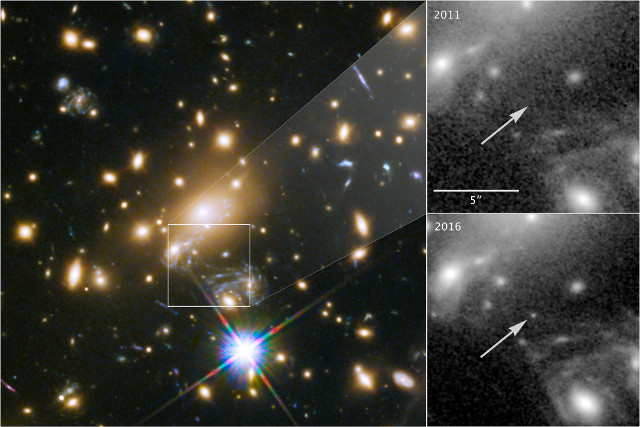
An article published in the journal “Nature Astronomy” describes the observation of the most distant star and therefore also the oldest observed so far, nicknamed Icarus, about 9 billion light years from Earth. A team of researchers exploited a double gravitational lensing effect that magnified the image of the star, which was called MACS J1149+2223 Lensed Star 1 but for that reason it’s simply called Lensed Star 1 (LS1). That effect made it become bright enough to be detectable by the Hubble Space Telescope.